|
|


H.M.S. APHIS
Dr. PETER J. MILLER
Surgeon Lieutenant
Royal Navy


Russ
Taylor and Dr. Peter Miller outside Peter’s home in

(Click to enlarge)
When I first met Peter, his first words were “It’s great to see the son of one of our shipmates”.
The Skipper of Aphis was Lieutenant Commander Frank Bethell, very well respected and liked by all. Second in command was Lt. Tony de Cossan, one of five officers aboard. There was a crew complement of 70 men, the same as on Scarab.
Peter served in North Africa, Sicily and Italy and went as far as Ascona on the East side of Italy. He was decommissioned in Malta and from there to Alexandria Military Hospital as a general duties officer in charge of a hospital ward treating patients.
Peter remembers his days on Aphis with fondness. As he said to me, “Those were the days…or were they?”
One poem he quoted to me was “The Ancient Mariner” (the young bright-eyed mariner).
Peter was born in Malta. At the time of his enlistment he was the
Chief Operating Surgeon at the
Below is a firsthand eyewitness account which is very intense – entitled “MAINLY MYSELF”
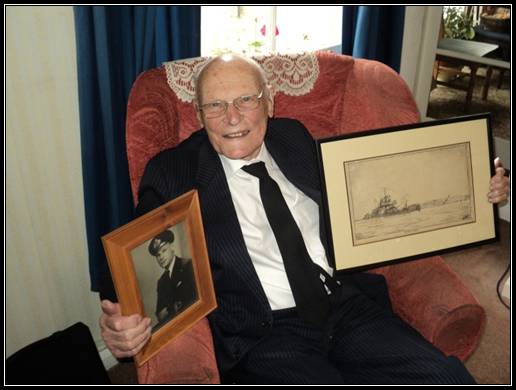
Peter seated with a photo portrait of himself and one of his drawings of
HMS Aphis
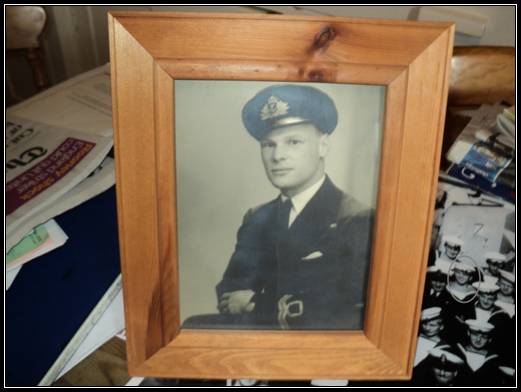
Close up of the photo portrait (used in his autobiography “Mainly
Myself”)
Note: Russ’s Dad (circled) in
picture
Former
Naval Doctor gives an account of his career to Air cadets
Posted by Danielle Hicks on Jan 28, 2010 in News
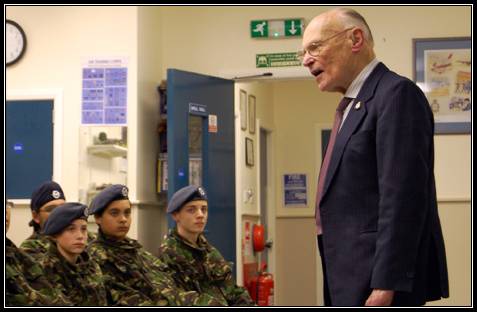
"Who can say they know someone who can thank the outbreak of World War Two for making their dreams come true? I can and I do".
These were the opening words by Peter Miller on a recent visit to 2438 Squadron Air Training Corps. The cadets listened as Peter Miller told them of his life's adventures and stories.
Born in Malta to a British Naval family in October 1917 Peter J Miller always wanted to follow in his father's footsteps and join the Royal Navy. Loving the water and his father’s naval stories his dream of following in his father’s footsteps were shattered after learning he was colour blind. Though he didn't want to do anything else as a career he decided that life on water was to be a distant dream so he set about becoming a doctor.
He trained as a General Practitioner at St Bart's College in
Knowing that there was a national shortage of service personnel Peter set about fulfilling his life's dream of joining the Royal Navy once again. Luckily for Peter even with his colour blindness, because there was a demand for naval personnel he was offered a place as a naval surgeon on HMS Aphis in the seas around the Mediterranean. He jumped at the chance to join the Royal Navy and set about fulfilling his life long dream.
Built in 1915 HMS Aphis was a Royal Navy Insect class gunboat. The Insect class patrol boats were a class of small, but well-armed Royal Navy ships designed for use in shallow rivers or inshore. The ships were designed to operate in shallow fast-flowing rivers, with a shallow draught and a good turn of speed to counter river flow.
On board the ship he was given the rank of Surgeon Lieutenant. As ship's doctor he was to treat everything from tuberculosis to burns victims, missing limbs, head trauma, flash burns and splinter wounds. As this ship was based in the Mediterranean, life as the ship’s doctor was very quiet for him but he still enjoyed his life on board.
Once the war had finished Peter settled back into civilian life and moved to Rugby to open up his own General Practice until he retired in 1982.
During and after his talk Dr Peter Miller showed the cadets photographs of himself taken during the war and paintings he had done of HMS Aphis.
Commanding Officer Flight Lieutenant Nathan Adams said "This was an excellent opportunity for the Cadets to understand a first hand account of what it was like to serve as a Doctor on board a Royal Navy ship in the Second World War. I think it is vitally important that the Cadets can have this experience whilst the generation that fought in the war can still pass on their experiences, so that the message from history can be passed on to future generations and not forgotten".
Dr Peter Miller still lives in Rugby and is the Chairman of the Rupert Brook Society and a County Surgeon for the St Johns Ambulance.
Source: http://cv3.coventrytelegraph.net/2010/01/former-naval-doctor-gives-an-a.html
The following is an
excerpt from Peter’s autobiography giving an account of his time on HMS Aphis.
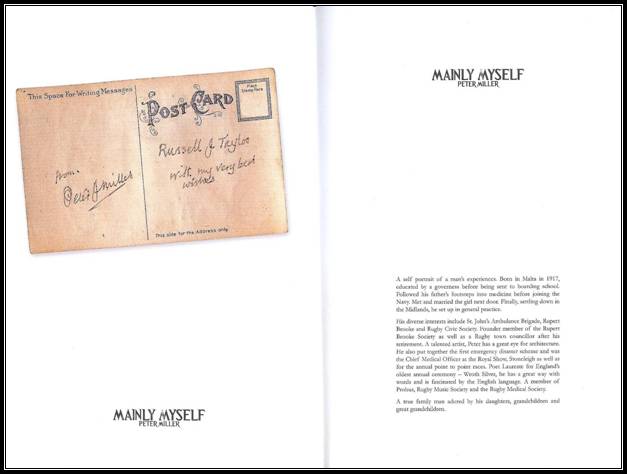
Mainly
Myself
By Peter Miller
Printed in 2010 by Limney Group,
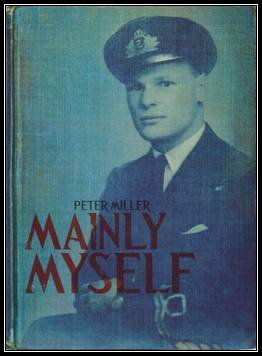
All text pages are supplied by Peter
Miller, Cover and image pages by Sean Hopkins.
This book could not have been
produced without the help and support of Peter’s daughters, Anne, Susan
and Jean
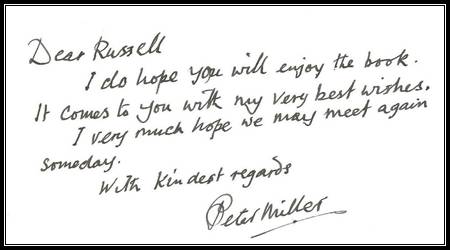
It was in March 1943 that I decided
I had had enough of hospital life and, as I have explained, was getting bored
with the routine of it – a routine in which I did not seem to be gaining
any education of any value or experience of any use. Besides which I was
beginning to think I should go to sea, which was after all what I had joined
the Navy for. So I went to the Fleet Medical Officer and asked for a ship.
‘What kind of ship would you like Miller?’ he asked. ‘Oh, I
don’t know Sir’ I replied, ‘perhaps one of those new
Hunt-class destroyers’ – destroyers that were doing such daring
work in the Eastern Mediterranean and in the Aegean. It seemed to me at the
time that he must have had a distorted sense of humour – though he was
probably only filling the next vacancy - for he eventually sent me to what must
have been the oldest ship in the British Navy, a China River Gunboat called HMS
Aphis.
The Gunboat – Armed with stings
‘Others like soldiers armed in
their stings’
(Shakespeare, Henry V, Act 1, Scene
2)
I first saw this little ship one
grey afternoon in March. She lay at her berth at one of the dockyard quays at
Alexandria, looking like no ship I had ever seen before, conspicuous by tow
disproportionately large guns, one fore and one aft of the box-like
superstructure which housed the engines and which was surmounted by two funnels
side-by-side. The guns were six-inch, heavier than her original armament; they
had a range of thirteen miles, and had been installed for the purposes of
offshore bombardment in the Mediterranean campaign. The engine-room of
necessity occupied the greater part of the superstructure for the
vessel’s draught was only five feet, while the freeboard – that is
to say the height of the ship’s side from the waterline to the deck
– was only three feet. We officers had cabins in the forepart of the
ship, where also was the wardroom; thus we lived between the upper deck and the
bilges, a height of eight feet.
The ships of this class, the
‘Insect’ class, had originally been built for service on rivers,
and at the end of the First World War Aphis, which had been built in
1915, had spent some time on the
I found
I had three fellow officers; the Captain, a thick-set, bearded, regular naval
officer, Lieutenant Commander Frank Bethell, R.N.; the First Lieutenant an
intelligent man of aristocratic lineage with traces of Italian descent, a
fluent Italian speaker, Lieutenant Tony de Cossan,
R.N.V.R., and finally the Sub-Lieutenant and Navigator Alaric Mortimore, R.N.V.R., who had been in commerce in West
Africa before the war. We were looked after by two Maltese stewards and a
Maltese cook and, when not on operations or in a heavy sea, were tolerably
comfortable. My sickbay had both port and starboard entrances and was situated immediately
under the bridge and wheelhouse being part of the main superstructure. It had
two bunks one above the other and a desk and a chair. The SBA (Sick-berth Attendant)
slept in one of them when they were not occupied by sick men. Our complement,
including officers, was seventy men; this was wartime manning and a very large
number to carry in such a small boat, but a very small number to engage the
attention of a medical officer.
Within hours of my joining the ship
it was ready for sailing and we left for Tripoli, in Libya, which was to be our
base for the time being. We were in fact following the Eight Army as it pushed
westward along the North African coast. As I had little else to do I found I
was in charge of the wines and spirits and the messing economy of the Wardroom.
The two Maltese stewards and the cook also from Malta were answerable directly
to me and I was answerable to my fellow officers for their contentment in
matters of food and drink. With so little to do life could be tedious; when the
ship was at sea I used to spend many hours sitting on a seat in the starboard
wing of the bridge.
We had not been long in Tripoli
before the three executive officers came together in the Wardroom with maps and
charts and other papers; the doors were locked, the stewards sent away aft, and
I was left to serve the drinks, having been dubbed ‘Security
Barman’ – an operation was being planned. I learned that we were to
sail by night across the Gulf of Gabes and bombard Rommel’s Headquarters
at Gabes. The proposed operation was discussed with relaxed professionalism by
the three officers, but even so there was an air of intense expectancy and I
soon learned that something momentous was being planned.
So far so good, we were to attack
Rommel, but we were not prepared for what happened immediately before our
expedition. On the evening of March 20th, soon after darkness had
fallen, the all-but-defeated Italians launched one of their last attacks.
Twelve Savoia-Marchetti torpedo-bombers suddenly
swooped on Tripoli and dropped circling torpedoes in the harbour. Seven of the
twelve were shot down, but not before they had inflicted considerable damage. A
petrol tanker was hit and went up in flames, its blazing cargo spread over the
harbour whose waters were soon completely set alight by the burning fuel. A
ship carrying munitions, the Ocean Voyager, had also received a torpedo
and was on fire. To add to this inferno, one of the shot-down aircraft crashed
in flames into a storage dump of hundreds of barrels of oil, only a few yards
from our ship. These instantly ignited, adding to the conflagration.
Aphis, like every other unit in Tripoli was pouring
anti-aircraft fire into the night sky. For a time, being the only unoccupied
member of the ship’s company, I sat rather wretchedly and apprehensively
in the empty wardroom. When our excessively noisy three-inch anti-aircraft gun
opened up immediately above my head, I thought for a moment that the ship had
been hit. I couldn’t sit beneath it for long and presently went on deck to
view the fantastic scene.
Just before midnight the Ocean
Voyager, only yards from us blew up. So great was the blast that the Aphis’s wire head rope parted and we were set
adrift by the bow. The munitions ship was cut in two by the explosion and the
two portions driven apart along the harbour bed; I subsequently learned that
the ship’s cat had been rescued unharmed from the fore part. One of the
ship’s boilers landed in the town nearly a mile away.
In the small hours of 21st
March we steamed out of the still burning harbour on our planned expedition,
escorted by five ‘Fairmile’ motor
launches. These were lightly armed patrol vessels, skippered mainly by R.N.V.R.
lieutenants, whose task was to act as escorts for Aphis, and later to
create a diversion by a coastal raid and feigned landing behind enemy lines
while we were bombarding. We had to travel a distance of some hundred miles to
our firing position, and as the next night fell we were still chugging along
escorted by our five small boats. In the first hours of darkness a twin-engined plane flew over us very low. We thought we
recognised one of our own Beaufighters and waved
ecstatically and exclaimed excitedly. Later we learned that there had been no
British aircraft in that area at that time and it must have been German. It
flew on and left us unmolested. It must have been a case of mutually mistaken
identity, we mistook the plane for one of ours and they must have mistaken us
for a German destroyer escorted by German E-boats.
As I have said our target was Gabes
and, as I subsequently learned, we effectively shelled the railway station and
a group of buildings that contained Rommel’s staff. The whole operation
which had been codenamed ‘Intrusion’, and included the diversionary
activity of the motor launches, had been intended to draw off enemy forces to
meet where they were supposed to think was a threatened landing in their rear,
and thus ease the pressure on
When all this was over and when in
the early hours of 22 March we turned for home we were aware that we must have
caused some disturbance and that the enemy would be out looking for us. After
all the excitement the thing was to turn in and get some sleep. Our escort had
rejoined us and I remember feeling uneasy about the prospect of enemy
reprisals. Sub-Lieutenant Mortimore, having achieved
this remarkable feat of navigation calmly announced that he was now going to
get some sleep. I remember being lead by his example and thinking, ‘If he
can sleep – well so can I’, and I slept soundly for several hours,
to be awakened by the noise of men murmuring and moving about the deck. It was
daylight and one could see a bright flaring light which had suddenly appeared
on the horizon as though someone had struck a giant match. It was the Heinkel 111, which had come out looking for us, being shot
down by our Spitfire escort.
When we returned to Tripoli, mission
accomplished, still accompanied by our escort, at the dawn of another day, the
fires had burned themselves out, and through the surrounding devastation we
regained our usual berth. The captain of the guard ship, a minesweeper,
anchored at the entrance of the harbour, who was a friend of our captain, came
aboard later that day for a drink. Over our glasses in the wardroom he said,
referring to his 3-inch gun, ‘I had one up the spout for you, and I
nearly let you have it.’ Apparently he had mistaken us for an enemy
marauding force. Also invited on board that day were the two New Zealand pilots
of the protecting spitfires that had saved us by shooting down the German
plane. We were keen to show our gratitude by plying them with drinks.
After the big shoot we had a couple
of fairly uneventful months cruising around and exercising, during which we
moved our base forward to Sousse which had since fallen to the Eighth Army.
While at Sousse I received orders from senior staff to board a captured Italian
hospital ship. I was instructed to interview the doctor and to inspect the
medical records, in order to establish the ship’s bona fides.
The doctor turned out to be a senior
surgeon of some distinction and I remember having a feeling of compunction, at
having to interrogate this dignified member of a profession in which I was
still a relatively inexperienced junior. I had to remind myself that I was
there as an officer of a conquering power interrogating an enemy officer to
make sure his ship was not carrying out clandestine operations while
masquerading as a hospital ship. He was polite and co-operative and showed me
everything. Later I wrote in my report to the Admiralty.
‘I was struck by the
convenience of such a small ship, the adequacy of her fittings, and by the
amount of useful surgical work that had been done actually at sea. When times
were quieter she had been employed in the regular evacuation of small numbers
of sick from the Italian islands to the mainland. She was understaffed for she
carried only one naval doctor, but her usefulness was undeniable.’
I remember wondering why we had not
got anything similar, and being conscious of the inadequacy of our own naval
medical service compared with that of the Italians.
Another diversion of our quieter
period came with the orders to land on a very small, uninhabited island in the
Gulf of Sousse and make sure it contained no enemy forces. Its emptiness seemed
obvious but anyway we did as we were told. I was of the landing party which was
very small – as I remember it we were only four – I don’t
think anybody took it very seriously; why I was there I can’t remember;
perhaps because I had nothing else to do. The party consisted of the First
Lieutenant, the Sub-Lieutenant and myself and one senior rating. We took Lee-Enfield
rifles. ‘Here Doc, you’d better have a rifle.’ they said,
‘B-but wha-what about the Geneva
Convention?’ I stammered. ‘Oh blow that!’ they said,
‘Just take one, just in case’. And so it was that we were put
ashore and walked in a leisurely way over the low featureless scrubland like
four sportsmen patrolling a Scottish grouse moor with our guns. I don’t
know what we would have done if we had encountered an armed enemy force but it
was pretty obvious this diminutive island was deserted. I can imagine a report
which might have read…’A landing party was put ashore from HMS Aphis.
No enemy resistance was encountered. Our force took possession of the island in
the name of the Allied Forces, etc…!’ We didn’t actually
hoist a flag!
The next step in the allied campaign
directed towards the invasion of the mainland was to subdue the
On 11 June the assault proper began.
A formidable invasion force had been mustered and Aphis was to participate in the preliminary bombardment. We sailed
from the Tunisian port of Sfax, which had by then become our base. In the event
the island surrendered after only a brief resistance. I was not surprised. I
can remember that soon after the bombardment had begun the island disappeared
under a pall of dust and smoke that rose high into the air. Aphis
started to bombard, accurately as we subsequently learned. The defenders
resisted from 9.30 in the morning until one o’clock in the afternoon. At
11.00 am the bombardment from the heavier ships had started; Aphis opened fire at 11.30 and I can
remember the incredible concussion and all-enveloping flash that ensued when
our two 6-inch guns were discharged simultaneously. For one brief moment I, who
never did know what was happening, thought the ship had been hit. At midday the
shelling had ceased and the assault troops had gone in.
We had on board with us a captain
R.N., who had come as an observer. We saw some of our bombers attacking the
island. The captain was almost beside himself with boyish excitement. We saw a
stick of bombs just released and, almost in slow motion, glistening in a
sharply defined pattern against the clear blue sky, before plunging downwards.
‘Look Doc! Look at the bombs! You’ll never see anything as clear as
that again!’ He could not have known that this sort of image would be
endlessly repeated on colour television for decade after decade. I can remember
being slightly shocked at war being treated as a spectator sport – all
very well when you’re on the winning side! Exultation was perhaps
understandable after the grim years of Allied defiance against almost
impossible odds in the Mediterranean. Yes the tide was turning in our favour,
but the Italian campaign had yet to be fought.
On the same day we had witnessed a
‘dog-fight’ by fighter planes over the island. Our ship’s
company stood on the deck cheering and yelling as though they had been at a
football match. But this was warfare; one of those pilots up there was going to
kill the other one. This mood of exultation arose from the fact that Pantelleria
seemed to be a walkover. This was a small thing against the bigger picture.
Italy was on the verge of surrender but there were to be nearly two more years
of war with countless further loss of lives.
Soon we left Sousse and, after a
brief sojourn at Sfax a little further up the coast, took up our berth at
Malta, where preparations were going ahead for the invasion of Sicily. It was
with a sense of some excitement that I came, for the second time in my life, to
the island where I was born, and which I not unnaturally came to love. I was to
see quite a lot of it during the years which ensued. It was while I was in
Tunisia that, by courtesy of the Army, we were taken on a desert motoring trip
to see Tunisia’s famous Roman amphitheatre. It was on the same trip that
we came to a totally deserted yet completely intact small Arab town and were
able to wander through it at will. The town had been evacuated because of the
war and was no doubt waiting to be repopulated. In the meantime I had the
fascinating experience of being able to explore a small Arab house with its
shady inner rooms and inner court where once a fountain played. Our army
friends looked after us well, supplying us with all necessities and lending us
a 15-cwt truck and a motorcycle. It was the only time in my life that I have
ridden a motorcycle and found it quite an exciting experience switch backing
over the bomb-devastated roadways and quaysides.
It was in Tripoli that I had again
met my brother. His Indian Army Service Corps unit was moving up with the Fifth
Indian Division, and we had somehow kept track of one another. He came to lunch
(Probably bully beef) in Aphis, bringing with him, memorably, a whole
leg of lame and two huge new white loaves. That made him doubly welcome, for by
that time we were on ships’ biscuits (‘hard tack’) instead of
bread and our meat was solely corned beef.
I had like being in
I had a cousin, Innes Westmacott, an R.A.F. Wing-Commander, who was something of
a hero of mine. He was one of ‘The Few’ who fought the Battle of
Britain. He is dead now, but in his lifetime he had survived three aircraft
crashes, including being shot down in flames in a Spitfire over his own county
of Essex. He was burned but fortunately not too badly. I had visited him in
hospital in Chelmsford. He described how, as he parachuted to safety, he had
spotted far below him, but growing ever bigger, his grandparents’ house,
the old Rectory, Wickham Bishops, and could clearly discern the familiar cedar
tree and the tennis court, in reassuringly peaceful contrast to what he had
just endured.
In Malta he described what he was
doing as ‘cloak and dagger’ stuff. I learned later that he was
flying a Mosquito over Sicily by night doing drops to one of our agents. He
arranged for me to have a flight in a Wellington bomber, and accompanied me as
we flew low over the water. The pilot took us down to no more than ten feet. I
was seated in the transparent nose of the machine and can remember the thrill
of flying so low over the water – so fast it was but a blur, so low that
one felt one could almost touch it.
Innes had another cousin in Malta
– another Westmacott, not my side of the family
– who was a Lieutenant in a submarine. He introduced me to him and he
invited us both to lunch in his vessel, which was in the dockyard. As we sat
elbow-to-elbow on a built-in settee against a narrow table in the ship’s
‘wardroom’, having our lunch served by the officers’ steward,
I was able to get some sense of the confined and claustrophobic nature of a
submariner’s life; but nevertheless in harbour, and for a guest there was
a clean white tablecloth and everything was spick and span. I went about quite
a lot with Innes, who introduced me to many of his friends, both service and
civilian, and provided me with a pleasant social background.
It was from Malta then that we set
out as part of the massive force assembled for the invasion of Sicily. Half way
across we broke down. A fault had developed in our ancient engines. It was
doubtful whether we should be able to continue and participate or whether we
should have to turn back. In the event our chief engineer fixed whatever was
wrong and we were able to proceed. I can remember that my feelings at the time
were anything but brave. If we had to return to Malta I reasoned my fear would
be set at rest; it wouldn’t be like running away; it would be out of my
hands and an honourable escape from the combat I was afraid of. So, half of me
wanted to return to the safety of Malta, and the other half would have been
mortified at missing the grand conflict. I was ashamed of my craven state of
mind.
We were part of a large bombardment
force, Force ‘A’, under Rear-Admiral Troubridge,
consisting a tow cruisers, three destroyers, the
monitor Erebus, the anti-aircraft cruiser
Incidentally, I saw Warspite
three times in my life. The first was the event in my childhood, which I have
already related, when my father was her P.M.O, then there was this occasion in
her war paint over thirty years later, and finally, as I climbed St.
Michael’s Mount, in Cornwall, in 1956, there she lay, stripped of her
upper works, a rusting hulk aground in Mounts Bay. The story was that, defiant
to the last, she had broken her tow during a storm while on her last passage to
the breaker’s yard and had been driven ashore. I later heard that the
ship had to be broken up where it lay and taken away piece by piece. But now this
was 1943, and there was the Warspite at the outset of the action,
glinting in the early sunlight of dawn, with her great gun-barrels etched
against the pale blue sky of a Mediterranean morning, reassuring to everyone in
that invasion force that her colossal fire-power was there to protect them and
speed their advance into enemy territory.
The Invasion of Sicily
Not a seat but a springboard
Churchill, Radio Broadcast, 29 Nov.
1942 (On North Africa)
Aphis was allotted to ‘Acid’ Beach. This
was the British sector and extended from a point just south of Syracuse to the
American area ten miles to the west of Cape Passero. The H-hour of D-day had
been designated as thirty minutes after midnight on July 10th, but
on the morning of July 9th a wind arose and the sea got up, yet it
was too late to stop this huge seaborne force which started off prepared for a
rough passage, but fortunately, by midnight the wind began to ease and by dawn
the force was lying off Sicily on a nearly flat and untroubled sea.
Soon the troops were ashore and
green flares began to go up, signalling initial success. Our job was to stand
off and shoot at any targets indicated by the Army. But I do not remember that
we were much called upon. In the initial stages of the invasion we simply lay at
anchor, and hung about in case we were wanted, or occasionally shifted
position, among the invasion fleet. At first we had on board an R.A.F. film
unit, whose camera was mounted on top of the engine-room superstructure
amidships. As the camera rolled, a Spitfire flew along the beach, quite low
above the heads of the troops. Suddenly there was a burst of automatic
anti-aircraft fire from some of the merchant ships and the Spitfire broke up
and exploded in mid-air. The officer in charge of the camera crew danced and
screamed with rage: ‘Oh you bloody, bloody, bloody fools!
You…you…Oh my God, you stinking criminal murderers! It transpired
that this was uncontrolled fire from trigger-happy U.S. merchantmen. It was a
distressing sight, but the hapless pilot was not the only one in the annals of
war to have been destroyed by friendly fire.
Aphis had a motor sampan, not a motorboat, but a
Chinese-built vessel driven by a petrol engine, which had been with the ship
since its China-river days. It was perennially broken down and the chief
engineer would from time to time tinker with it, but to no avail. Consequently,
whenever we wanted to go ashore, we had to row. We had a whaler, a small
carvel-built lifeboat or tender, with four oars and two sails, as our other water-borne
transport. I don’t know why the naval authorities had not thought of
supplying us with a replacement motorboat, but so it was, and wherever we
wanted to go we had to row ourselves. It was like being in Nelson’s navy.
We would either have four or two men at the oars, depending on circumstances,
and often the officers would take a turn, which was quite an enjoyable form of
exercise. It was the only safe means we had of going from ship to ship in the
invasion anchorage.
I don’t know how many medical
officers there were scattered about the invasion fleet, but I would
occasionally be invited to render medical assistance to ships that didn’t
carry a doctor. One way of summoning a doctor was to fly the appropriate flag
asking for medical assistance. One of the American ‘Liberty’ ships
– 10,000 ton cargo vessels – had been flying this flag, we
didn’t know for how long exactly, but my captain told me to go and see
what was wrong. They must have forgotten to take it down, for when I got there
it turned out that it had been flying for several hours and that they had
already had a visit from a doctor who had had the sick man evacuated. When I
had started out in the rowing boat I hadn’t the faintest idea what I was
going to encounter, so I had taken my surgeon’s emergency field medical
case plus an enormous bright metal autoclave drum full of sterile dressings;
these two packages I had slung round my shoulders by means of two knotted
triangular bandages.
On arrival at the ship my boatmen,
who had orders not to stay away from Aphis longer than absolutely
necessary put me off at the bottom of a rope ladder and turned around and rowed
away.
At this stage no one had thought of
shouting down that a doctor was no longer needed and I started with my unwieldy
burdens to climb the rope ladder to the ship’s deck high above me. At the
end of this perilous climb I had to grasp the edge of the ship’s side and
heave my legs over on to the deck. At that precise moment my centre-of-gravity
seemed to shift and I felt myself falling, pulled backwards by my heavy load.
Wildly I flung one arm forward, managed to grasp the ship’s side and
landed safely on the deck, saved by a whisker from what could have been a nasty
outcome. The ship’s officers apologised profusely for their mistake in
forgetting to take down the signal flag, and promised to signal my boat back as
soon as possible. In the meantime…I heard a voice saying, ‘Could
you use a steak?’ Well it was wartime and I hadn’t seen a steak for
quite some time. They sat me down in front of what must have been the biggest
and juiciest steak that I’d ever seen. A welcome consolation and one of
the outstanding food experiences of my life.
At some stage of the invasion, I
forget exactly when, one of our destroyers had been so badly damaged by enemy
action that it had had to be abandoned. It had caught fire and, still burning,
would have served as a beacon to enemy bombers. So a decision was taken to sink
it. Several of our ships concentrated their fire on it. It was a horrifying
sight even though we knew there was no one aboard. Fresh fires were started,
new holes continually appeared, so that presently the blazing ship took on the
appearance of a giant watchman’s brazier, until the destruction was
complete, and the fragmented ship plunged beneath the surface. It was a
fearsome spectacle and one, which had effectively demonstrated the awful
destructive power of high explosive.
I only to leave my ship once more
while with the invasion fleet and this was to put a drip on a casualty who had
been badly burned and arrange for his evacuation. We had with us a hospital
ship, white with conspicuous red crosses; it had a full complement of doctors
and nurses and every possible facility; by night it was brightly illuminated
and had a huge cross picked out in red bulbs, conspicuously visible from the
air, on top of the superstructure. It was to this ship that I had to send any
of my patients that needed hospital care.
After a few days when the battle in
our vicinity had ceased and the front line had moved on, we had become so
established at our anchorage that it was possible to go ashore and buy freshly
picked lemons and Marsala wine. This we did on several occasions – rowing
the ship’s boat as usual. On one such occasion my Captain, Lieutenant-Commander
Bethell had gone with several ratings and another officer, I was not with them,
and had landed in a little cove. There on the beach they discovered the bodies
of English army nurses, clad in their full white uniforms, together with the
bodies of their patients, washing about in the sandy shallows. The shock was
tremendous, for this was the first intimation we had as to what had happened to
the hospital ship. It had been sunk the previous night by an enemy aircraft
dropping a bomb down its funnel. This was no accident; it was a deliberate act
of vengeance, by an enemy already feeling himself defeated.
When the landing party had returned
with this awful story, and the full and ghastly significance of it had sunk in,
I can remember recalling certain words in Shakespeare’s Henry V,
and feeling a surge of hatred and loathing of the German enemy which perhaps I
had not quite so intensely felt before. Shakespeare has King Henry saying, when
he is told that the defeated French, fleeing from the battle, had entered the
undefended English camp and slaughtered all the boys; ‘I was not angry since I came to France until
this instant.’
Many years later I was recounting
this event to a lady who had been an army nurse, when she said, ‘but
didn’t you know, we did that to one of theirs.’ I had immediately
replied that I didn’t think we British could have done such a thing on
purpose – it must have been an accident, I said, whereas the hospital
ship at
Bit by bit we made our way up the
coast and eventually took on board a bombardment liaison officer (BLO) to
direct our shooting. He was a captain in the Royal Artillery and for some days
lived aboard with us. He was a pleasant enough chap except for one irritating
habit. He would sit on the bridge, as we were cruising up and down, singing
softly to himself over and over again, like a mantra, to the tune of the
opening bars of Beethoven’s Fifth Symphony
‘Kentisher
Byng stood for his King,
Letting the crop-headed parliament
swing’
Until
we were all driven crazy by it.
Together with our BLO we nosed,
slow, tentative and searching, up the coast. Nothing much seemed to be
happening, although we knew the army was steadily advancing. The beauty and
apparent tranquillity of the scene was remarkable; nothing to disturb the calm
of Shelley’s ‘…blue Mediterranean where he lay, lulled by the
coil of his crystalline streams’, when suddenly there arose beside us a
tall spout of white water; we were being shelled. Fear is de-humanising. I was
petrified as further shots fell nearer and nearer. I felt momentarily gripped
by a kind of all-devouring terror. What should I do? How should I behave,
standing there on the deck under a canvas awning? There’s not much you
can do about it when you’re being shelled anyway, and I was very conscious
that many pairs of eyes would watch my demeanour and bearing. As ever the M.O.
had no tasks other than stand and wait, a state of affairs demoralising in itself. As the fourth spout arose, just astern of us and
uncomfortably near, the First Lieutenant thrust his head out of the Training
Station – the small gunnery control office in the superstructure –
and said, ‘How close was that one Doc?’ Willing myself to an air of
nonchalance that I did not feel and trying to speak casually, I replied,
‘Oh, I dunno, about a cable’s length.’ (200 yards) He looked
astern at the patch of white water subsiding in our wake and said,
‘Don’t be a bloody fool, Doc, half a cable!’ At that
point the captain gave the order to put the wheel over and we turned 180
degrees and steamed away. No more shots fell; we were soon out of range. I
learned that a 9-inch railway gun had opened up on us. It must have been at
extreme range. If only the gun-captain had waited until we were well within his
range he could have blown us out of the water. With our decrepit engines we
could at that time only make eight and a half knots anyway.
Soon after this we learned that
there was no further call for Aphis’s
guns for the time being and we withdrew to a safe distance from the enemy and
dropped anchor in a little bay enclosed by green hilly headlands. Soon came the
‘pipe’, All hands to bathe’ and
presently, within a short while of being shelled, we were splashing about,
totally relaxed, in the warm sea. I was enjoying the swim and had stayed in alone
long after the others had climbed back to the ship. I was close to the ship
when suddenly I became aware of a disturbance in the water quite near me; it
was as if someone had thrown a handful of pebbles into the water. Then the next
thing I became aware of was a roaring and rushing sound as an aeroplane pulled
itself steeply away from near ground level. It was a Messerschmitt 1090 that
had come from behind the headland and had just shot us up. As I climbed up the
short ladder to the deck everyone was picking themselves up off the deck and
dusting themselves down; there was a hole through the
funnel, but no other damage, and miraculously no one was hurt. It was only then
that I looked down at my left shoulder and found it densely streaked, down to
the elbow, with black marks. I then realised that these were the marks made by
exploding cannon shells, which explained the strange disturbance in the water
near me, and suddenly brought home to me how near death I had been. In that
same day that I had been consciously and miserably seized by the fear of death,
I had been brought even closer to it and yet utterly and blissfully unconscious
of it.
After these incidents we moved
steadily northwards towards the toe of Italy, stopping meanwhile, for short
periods at the ports of Augusta and Catania, passing the cliff-built town of
Taormina and gazing with tantalised yearning at its incomparable beauty as seen
from seawards. How we would have loved to stop the ship, drop anchor and go
ashore and explore this jewel of the Mediterranean, but our orders did not
allow of this and we steamed slowly by until the high-built dwellings of this
wonderful town had faded from view. The pace of the war was such that we never
did have time or opportunity to explore this ancient and beautiful land. I
convinced myself that I would go back when the war was over but I never did.
Messina was captured on 17 August
and soon after we were berthed in the harbour there, awaiting the invasion of
Italy, the ‘gran disbarco’ that
the harbour-side urchins told us would soon take place. How did they know we
asked them? ‘Oh, the Americans tell us’, they replied. We had spent
some time in Augusta, which has a huge bay and a magnificent natural harbour
and had been a base for the Italian navy. While there I was taught to use a
service revolver and fired several shots into butts, for me another
near-infringement of the Geneva Convention, but the ship’s officers said
that I might need to use a revolver in self-protection. In the event no such
situation arose, and we saw little further of the war until the massive and
amazingly peaceful and untroubled crossing of the armies into Italy took place.
We may have fired a few rounds in support of the landing-craft that crossed the
Strait of Messina and put the army ashore in Calabria, but I have no very clear
recollection of this … nevertheless I am tempted to include at this point
a quotation from A. Cecil Hampshire’s Armed with Stings:
One hour before first light on
September 3rd three hundred Allied landing craft headed for the
beaches of the Italian mainland just north of Reggio. Within their steel hulls
they carried the battle-hardened troops of the XIII Corps of the Eighth Army.
The soldiers had come a long way from Alamein, but in the mists of that
Mediterranean summer morning they could descry the squat silhouette of one of
the Navy’s hardest fighting warships which had accompanied them
throughout their long triumphant advance, her guns as usual spouting flame in
their support. She was the Aphis, and with her was the Scarab, as yet an
unfamiliar figure to the troops except for her outlines.
This crossing of the Allied forces
into Calabria, although supported initially by a barrage of naval and military
gunfire, was almost completely unopposed; it was well established by the end of
the first day and, by the end of the third day, 35,000 troops and nearly 7,000
vehicles had been ferried to the mainland. The Germans had withdrawn their
forces and were in full retreat to the north. This first invasion of the European
mainland came to be known as the ‘Messina Regatta’.
A bright sunrise on the morning of 8th
September saw Aphis in position in the Gulf of Santa Eufemia
off the small port of Vibo Valentia Marina. I remember this tranquil morning
with a soft breeze and a calm sparkling sea, the wardroom scuttles wide open to
the gentle weather, the breakfast laid and served by the stewards; I was alone,
the other officers having gone on deck to their stations. This was the
beginning of Operation ‘Ferdy’, an invasion planned to land a large
body of troops behind enemy lines in the toe of Italy, and, as I finished my
meal in relaxed physical comfort, I suddenly became aware of gunfire from the
beach several miles away, of smoke arising. One of the first waves of our
landing craft had been hit; the army were encountering resistance. What a
contrast, I thought at the time, between me in comfort in my ship and the poor
bloody infantry slogging their way ashore in the teeth of enemy resistance.
Aphis, Scarab and a monitor HMS Erebus
were standing at some distance offshore to give fire support to the army. What
had happened was that the Italian, on the verge of total national collapse, had
ceased to offer any resistance and the planners of the operation had expected
to encounter very little opposition at this port so far behind enemy lines.
They had expected it to be largely undefended but, as luck would have it, the
crossroad at that moment was thronged with retreating Germans and their
artillery. The night had been dark and the harbour had proved difficult to
locate, so that what was to have been a night action at 2.30 am had become
delayed till an hour before sunrise. So it was that what was to have been
almost a walkover had encountered an unexpected level of resistance and the
invading forces had a tough time of it with unexpected numbers of casualties.
The guns of the retreating army had
been turned on the invaders. With the element of surprise lost and the landing
delayed, these unexpected guns were only too effective and, to get into the
harbour the two tank landing ships (LST) had to run the gauntlet of enemy fire.
This they managed to do but one of them was hit many times and some of her
vehicles were blazing. The ship remained a target for the German guns until
they could be silenced. Rear-Admiral Roderick McGrigor, in command of the naval
forces, had flown his flag on a motor torpedo boat and this too was hit and
sunk and the Admiral wounded. Undeterred he transferred his flag to a motor
launch and the assault went on. Soon the big guns laying to seaward became
effective and one by one the enemy gun positions were put out of action. I
remember a call for fire being made to Erebus and hearing a shell from
her 15-inch gun passing overhead; it sounded like an express train; soon came a
signal over our radio – ‘Position obliterated!’ I thought
then, how satisfactory for us, but how awful too; somehow I thought of the
wives and girl-friends of the gun crew writing letters to them, little knowing
they were blown to bits. An enemy, yes, but they had also been part of
Earth’s mankind and they had just ceased to exist; such is warfare!
The wounded man was a signalman in a
Flak Landing-Craft,
I wrote in my report to the Admiralty, and his case illustrates some of the
difficulties of treatment and disposal of casualties during landing operations.
I was writing in a state of dismay and anger; at Vibo Valentia we had been 20
miles in advance of the Eighth Army positions in Calabria and even further from
a major hospital or hospital ship. I had received no instructions whatever
about the evacuation of casualties and had the impression that no such
arrangements had been made. The landing craft had pulled offshore with two
wounded and had requested medical attention. One of the wounded had a severe
head injury and for him I couldn’t do much. The other, whose life I tried
to save, had a shrapnel wound of the chest and was bleeding internally.
My captain had put the Aphis
within a cable’s length of the flak craft and I was rowed over to it in the
whaler. When I saw how badly injured was the man with the chest wound I decided
that I must put up a drip; so I returned with my Sick-Berth Attendant (SBA) to
my ship to collect the necessary gear. On my return to the wounded man I found
his condition had deteriorated. I put up an intravenous infusion of plasma by
cutting down a vein at the ankle and inserting a cannula. I had chosen this
method as I hoped to be able to give him some blood later. I had left him in
charge of my SBA while I returned to Aphis, having arranged to take blood from
a donor. At this stage I had persuaded the captains of both ships to draw
alongside each other and remain thus for a short period. First however I had to
be prepared to start another bottle of plasma while I was getting the blood,
but when I returned to my patient I found that in a state of increasing
delirium and restlessness, he had kicked the cannula out of the vein; so my
attempt at resuscitation had been useless.
By then it had become obvious that
the casualty would have to be transferred. I had already asked the captain of
the LCF to go alongside HMS Erebus and had had a short consultation with
that ship’s two medical officers. By then I had been in the landing craft
for quite a long time and if I was to give blood as I had originally intended I
should have to expend further time going from ship to ship, to say nothing of
bleeding a donor and repeating the cut-down operation on the other foot. I
decided that I could not stay with the patient any longer, as the Aphis was standing by for bombardment.
Accordingly he was transferred to Erebus, which ship had at least got
the proper facilities.
When he was struck by the shrapnel
he had been moved by his shipmates off the upper deck, squeezed through a
narrow hatchway and down an almost perpendicular ladder. Now, in his weakened
condition and strapped to a Neill-Robertson stretcher, he had to be got up the
ladder. This proved to be almost impossible due to an unwieldy hatch-cover
– rather like a small sentry box – which was permanently welded
into position above the square hatch. Inwardly I cursed the designer of this
ship and simply could not understand how anyone could be so stupid as to design
a hatchway like this in a ship of war – bitterly I reflected that thousands
of this design had been mass-produced without anyone considering the problem of
getting wounded men through this kind of hatchway.
I found it inconceivable that this
problem had not been addressed while the ships were being built; in the same
way I found it inconceivable that no orders or guidelines had been issued
regarding the sea-borne evacuation of casualties in an operation such as the
present. Throughout my sea-going service in the Med I had received no
instructions whatsoever about back-up medical services or about the evacuation
of casualties. In discussion with other naval doctors I satisfied myself that
this was because none such existed. No directives had been issued to naval
doctors in my position, and it seemed to me that the most senior medical
officer on this war zone was exercising merely the functions of personnel
management, drafting and stores departments, and it seemed to me that all
medical planning for combined operations had been left to the Army. As in
Nelson’s day we were isolated in our ships and left to get on with it.
While in Alexandria I had met the
Surgeon-Commander of the anti-aircraft cruiser Carlisle; we found we
both had the same ideas about the lack of plans for evacuation and treatment of
casualties in combined operations. We agreed about the need to equip and staff
landing craft as sea-borne first-aid posts or advance dressing stations in
which casualties could be resuscitated while they were being evacuated. These
ideas we were going to put into a joint paper which we were going to write to
the admiralty next time we met. We never did meet again and the paper was never
written, but I did put these ideas into the report I wrote about the Vibo
Valentia affair. The Admiralty acknowledged it with a laconic, ‘Your
remarks have been noted in office.’ There was no further comment and
I heard no more, but I did hear that some such vessels as I had suggested were
in fact used in the D-Day landings in Normandy.
The operation off Vibo Valentia,
although much more hard-fought and bloody than anticipated was nevertheless a
success, our troops had cut off the retreating Germans and the ground had been
well prepared for the landings at Salerno, which took place soon after. As we
stood off that day waiting for fire-orders, there came the news over the radio
that Italy had surrendered. It was late in the day and the action ashore was
winding down, the ship’s company were ecstatic and rejoicing as though
the war was already won. I was sitting peaceful and relaxed in the wing of the bridge,
reading Henry Williamson’s The Dream of Fair Women when, as if to
remind us that the war quite definitely was not over, there came an enemy shell
at masthead height which just missed me, passing whickering and snickering over
my head, to plop harmlessly into the sea. I continued my reading. This proved
to be the last time that Aphis was fired on while I was with the ship.
Following the attack at Vibo
Valentia we pottered about off the coast of
This scene, so well remembered by
reason of its beauty and charm, was for me my last contact with Italy while
serving in Aphis. Soon we had orders to return to Port Said to repair
our flagging engines and replace our worn-out gun-barrels. As an MO I had no
brief to remain with the ship over a long refit and I was removed and sent back
to Alexandria after only just over nine months service with the ship. It wasn’t
until more than fifty years later that I learned of the subsequent adventures
of this little warship.
As I was preparing to leave, I
carried out the last clinical act in my not overfull ‘casebook’, it
was to lance a very large abscess, this I did by administering to the patient a
short-acting intravenous anaesthetic. In Port Said, at that time, routinely at
midday, there would be a practice anti-aircraft shoot when literally every AA
weapon in the harbour would blast-off simultaneously. It so happened that the
anaesthetic was wearing off just as the shooting began. Emerging boozily from his stupor my patient exclaimed in a thickly
slurred voice, ‘Bloody good, Doc. Performing an operation under
fire!’ And so nine months of virtually no clinical work amongst a small
group of mainly healthy men ended with a bang.
Minesweeping
You missed that one – you want
to get your eyes tested!
A fellow officer in HMS Fareham,
said to me
My next ship was a minesweeper. And
so I went watching for mines and came to realise that I was slightly
short-sighted and the next time we put into Malta I went to an optician and got
myself fitted out for the first time with glasses for distance vision. One
couldn’t afford to miss spotting mines as they bobbed to the surface
their moorings having been cut by our sweep wire. My job during minesweeping
operations was to stand on the bridge and provide an extra pair of eyes to call
out instantly as a mine broke surface. What better job for an otherwise idle
medical officer?

Print
of a Royal Navy Insect Class Gun Boat on the Yangtze River,
From Peter’s collection.


H.M.S. Aphis
Painting by Peter. J. Miller
Bombardment
of