|
H.M.S. BIRMINGHAM
CLIFFORD REGINALD TURNER
Electrical Artificer
Service Number: PMX 86407
Royal Navy
October 1945 To June 1949

Clifford Reginald Turner
Author’s note:
In the
course of preparing this website I have enjoyed many surprises and
unexpected insights as well as met some amazing and fascinating people.
The
following contribution was received from Mr. Cliff Turner of Hamilton, New
Zealand and I have had the pleasure of connecting him with Mr Frank Bee
(also a former crew member of Birmingham) whose own contribution appears on
the site. They have since been in contact with each other and have enjoyed
a most satisfactory catch-up.
Cliff’s
story covers the years 1925 until circa 1951. His record is a unique
first-hand account and we have chosen to include it exactly as quoted to us
and not to leave anything out.
For
details of his time in the navy and on HMS Birmingham click here: The
Navy
Photo Enlargement
All photographs can be enlarged. Simply click
on the item you choose.
___________________________________________________________________________________________________
|
December 2012
From Cliff Turner:
I have just seen your piece about the Birmingham. I
joined her in Oct or Nov 1945 as an electrical artificer. At Christmas
King Christian of Denmark arranged for a parcel of Danish cheese,
butter and bacon to be delivered to the homes of all the ships crew.
Although I had not been present when the ship went into Copenhagen at the
end of the war my family received a very welcome parcel. I am now 87;
there will not be many recipients still alive.
|
My main reason for contacting you was to tell you about
the gift of food that all members of the crew had from King Christian X.
Your Dad's family must have one.
I joined aged 15 yrs 11 months as an artificer
apprentice in Feb 1941 but since the training took so long the only action
I saw was being bombed during the blitz on Plymouth. So the war had been
over for a few months when I joined Birmingham, my first ship.
Thanks to you I now know that the captain when I joined
had not been in the ship very long as the captain in Copenhagen had a
different name. Most of my messmates had been in the ship for some time,
including the torpedo in the Med and the repairs in America. I had never
heard any mention of Monty visiting when they were in Copenhagen.
I am doing a bit of a story for my family and mention
the Artisans Mess winning the Carley float race at the Home Fleet regatta
in Portland Harbour in early 1946. Now I can show them a picture of a
Carley float.. The crew chose me to receive the prize, 10 shillings each,
from the C-in-C Admiral Sir Neville Syfret.
Soon after that we did a 6 weeks cruise to Gibraltar,
Trinidad, Jamaica, Bahamas and Bermuda. We went to Cardiff for the
celebration that took place a year after the war ended and soon after that
visited Hull, Scarborough, Hartlepools and North Berwick.
Then to Portsmouth for a major refit before going out to
Trincomalee to join the East Indies station, getting there towards the end
of 1947.
We went to Rangoon for its independence day in January
1947. We took the last British Governor back to Ceylon where he caught a
ship for home.
In all I spent more than 3 years in Birmingham and was
the "oldest inhabitant' when I left in early 1949. I had joined for 12
years from the age of 18 but managed by political agitation to get out of
the navy in June 1949, as I hated the conditions under which we lived.
Cliff
___________________________________________________________________________________________________
April 2013
Thanks a lot Russell for your work. I am really
delighted with it and I know my family will treasure it. I also intend to
forward it to a few other people.
Although I was unhappy in the navy I would not change
anything in my life as what I learned led to a satisfying life with a
wonderful wife two successful daughters and 6 lovely grandchildren.
Best wishes,
Cliff

HMS Birmingham Light Cruiser at sea - June
1946
Brigg,
where I was born on 21 March 1925, is a small market town in North
Lincolnshire. It stands astride the River Ancholme about ten miles south of
Ferriby Sluice where the river flows into the River Humber.
Brigg has few
claims to fame. Music lovers may be aware of Delius' rhapsody Brigg Fair
but find it difficult to find Brigg on a map, and some devotees of the
theatre may know that actress Joan Plowright was
born in a Brigg council house. She is a few years younger than me so it is
possible that I saw the future Lady Olivier in her pram.

Cliff (left) with his brothers Ken and John and
his mother.
Most of my
father's ancestors came from North Lincolnshire. My Great-Granddad Charles
Turner, who died long before I was born, came from Barnetby. In the 1871
census he was living at Broughton in the house of a farmer, George
Marshall, and was described as a servant. Two other young men were living
in the house so it would seem likely that Charles was employed on the land.
In 1881 he was living at 9 West Terrace in Brigg, married to Harriet (nee
Maddison). They had a daughter, Annie, aged two. He was listed as a
brewer's drayman. I do not know how my Great-Grandma regarded this
employment as I remember she used to wear a little enamel brooch in the
shape of a white ribbon. It was only after I came to New Zealand that I
became aware that the badge was the emblem of the Women's Christian
Temperance Union.
The 1891
census show Charles was still a brewer’s drayman but living at 34
Grammar School Road, Brigg.
This house
was known as Oakleigh House and not the kind of house that a brewers
drayman could have aspired to. At the time of his death from tuberculosis
at the age of 42, in July 1895, he was a pork butcher. Family legend is
that the pork butchers business, which persisted for four generation of
Turners, was started by Harriet, so it seems likely that Great-Granddad
carried on working as a drayman for a while and then joined his wife in the
butchers business.
After she
was widowed, Great-Grandma married Francis Richardson in 1898, so my
brothers and I knew her as Grandma Richardson. I have a picture of Brigg
market place early in the 20th century which shows a stall carrying the
words "F. Richardson, Pork Butcher, Grammar School Road, Brigg".
Francis died in 1912. At the 1911 census my Grandfather, also Charles, was
still a cabinet maker.
1939
– 1945
War
Towards the
end of August 1939 we had the only family holiday we ever had apart from
short stays with my Hills grandparents and, for Ken and me, a few days with
our Uncle Harry and Auntie Alice at Whaplode near Spalding. The
holiday was on the Lincolnshire coast at Mablethorpe; we rented a caravan
and a tent from a Brigg cobbler called Melton. Mum, Dad and John slept in
the caravan and Ken and I had camp beds in the tent. Mr Melton took
us all in his car on a Sunday and brought us back the following Sunday,
which was almost the last peacetime Sunday before the war. I think we
had not seen a newspaper for the whole week and when we got home again we
realised that war was a distinct possibility.
It was
while I was swimming at Castlethorpe Bridge that my mother came along the
towpath to fetch me home because the Germans had invaded Poland. Perhaps
she thought Brigg would be singled out for immediate aerial attack. We knew
of course that war was imminent. I think it was in March 1939 (but it may
have been September 1938) that every man, woman and child in Britain were
given a gas mask and I remember going to Glebe Rd School to get
mine. When school broke up for the summer holidays in July 1939
Headmaster Daughton told the assembled boys that he believed in "the
power of prayer" and asked us all to pray for peace. On Sunday
September 3rd at 11.00 a.m. we gathered round the radio to hear Prime
Minister Neville Chamberlain tell us that we were at war with Germany. Our
neighbours Horace West and his sister Mary came to listen as their radio
needed a new battery and the sight of their anxious faces is one of my most
enduring memories.
In the
early hours of Monday 4 September the air raid warning siren sounded; we
got out of bed and dressed and went downstairs. Mother's reaction was to
make a cup of tea. I cannot recall how long it was before the "All
clear” siren sounded and we all went back to bed. It was this
warning that caused Great-Grandma Richardson to go downstairs and die in
her chair. It later transpired that the warning was a false alarm. In fact
it was several months before bombing started in earnest although a few
bombs were dropped near the Forth bridge in Scotland and at the naval base,
Scapa Flow, in the Orkney Islands north of Scotland.
Similarly
not much fighting occurred in France where the British Expeditionary Force
was sent soon after the war started. Conscription of young men had started
in about March 1939 and so there were few trained conscripts and the men
that went to France were mainly regular soldiers and
reservists. Reservists were men who had served as regulars in the
armed forces and had then accepted a retaining fee to stay on as a reserve.
Reservists were mobilised a day or two before the war broke out.
The air
force carried out raids over Germany early in the war but instead of
dropping bombs they dropped leaflets urging the German populace to turn
against their Nazi masters. The period from September 1929 to 1940 became
known as the "phoney war" because so little happened in Britain,
Germany or France.
By contrast
the war at sea started almost from Day One. The Athenia, a ship carrying
lots of children to what their well-to-do parents thought would be safety
in America, was torpedoed with considerable loss of life. A German
submarine managed to get through the defences at Scapa Flow and sink the
battleship Resolution and in November came the cheering news that the
German pocket battleship Admiral Graf Spee had been destroyed off
Montevideo in Uruguay by the cruisers Exeter, Ajax and Achilles. The
Achilles was a ship of the New Zealand navy. The Graf Spee had already sunk
many merchant ships and the crews taken prisoner were put into a ship
called the Altmark. I cannot recall how this ship came to be in a Norwegian
fiord, but while it was there it was boarded by men from HMS Cossack and
the prisoners were taken back to England.
This story
seems to be degenerating into a History of World War II. Winston Churchill
covered that in about 5 volumes so I will not compete against him but get
back to the original purpose of this magnum opus.

Cliff in the backyard at 5 Princes St.
Mention of
the Wests reminds me that I have not chronicled our move from 5 Princes St
to 4 Redcombe Lane. This took place, I think in 1938. I know we were
still in Princes St when the Glebe Rd headmaster came round in about mid
1937 to tell us brother Ken had passed the scholarship exam for the Grammar
School and that we had been there quite a time when the war came. I do not
know why we moved but perhaps the new house was marginally better than the
old. It had a separate kitchen and there were three bedrooms on the first
floor. At Princes St. we kids had to climb two flights of stairs to
our attic bedroom. The front door did not open directly on to the street;
there was a fenced area about the size of two tabletops between the house
and the pavement. One advantage was that it was much nearer to school.
An old man had lived there alone for several years and the house was
filthy. The owner, Mr Clark, gave my parents two rent-free weeks in
recognition of the amount of work they put in to clean the place up.
Unlike
Princes St, which did not have a square centimetre of soil, we had a back
garden and a pigsty. The copper for washing clothes was not in the
back yard but in the kitchen, which meant that on washdays, the house was
filled with steam. Toilet facilities were as primitive as those in Princes
St. The house was very dark. The window in the living room faced north
and that in the kitchen looked to the west. Any Southern Hemisphere
readers are reminded that in England it is the north side of a house which
never gets any sun. The house was at the west end of a block of four
which was why we had no windows facing east to the morning sun.
I ran
twice, in 1939 and 1940, in the school cross race over about 7 km coming
about 30th out of about 120 runners on my second attempt. As I was only 15
and there were 16 and 17 year old boys running, I thought that was not a
bad result. I recall that as I approached the finish one teacher
called out “Well done, Turner".
School
Certificate came in June 1940. The Germans had just overrun Belgium,
Holland and France so things were looking a bit grim for Britain but
nevertheless the exams took place. When the summer holidays started my
brother and I went working with several other boys, mornings only, in woods
near Scawby sawing pine tree trunks for use as pit props in coal mines. I
think we were paid 5 old pence per hour. The summer holiday was shortened
so that another two weeks off school could be given in the autumn for youngsters
to work in agriculture.
Looking
back to 1940 I realise that children at that time had little or no idea of
the peril we were in. If the Germans had not attacked Russia but had
concentrated their efforts solely against Britain the war might have had a
very different outcome.
Soon after
school restarted the School Certificate results arrived. I had credits in
English, English Literature, French, Latin, Physics, Chemistry, Maths and
History and a miserable pass in Geography. Of the boys staying at school
after School Cert those who had done well enough progressed to the sixth
form while others went into a form called Remove to have another attempt
the following year. In the sixth form pupils had to make a choice, between
Maths and Science or Modern Studies. Modern Studies meant languages,
literature and English. I chose Maths and Science.
When the
autumn holiday came my brother and I went to a farm at Wrawby to pull and
bag carrots. We were paid five shillings a day - riches to us but most of
it went to mother.
The Navy
I was not
very happy in the few months I spent in the sixth form; probably because I
knew I was likely to go into the navy. When the results of the navy exam
came I was high enough up the list to be able to choose to go into the
electrical branch. The other choices were engine room or ordnance. I
also lost time at school because when I had my medical for the navy at
Derby I was told that I had to be circumcised before I could be accepted.
The job was done at Scunthorpe hospital. I did not know then that it was
normal surgical practice to shave areas adjacent to the part of the anatomy
to be operated on so you can imagine what I thought was going to happen
when a screen was put round my bed and a man came in carrying an open cut-throat
razor.
Looking
back it seems silly that I should have stayed at school until two days
before going into the navy. It might have been more sense to have taken a
job, however menial, for a few weeks. Eventually I was told that I had to
be at Torpoint, Cornwall, on 24 February 1941.
That was a
Monday and I went to school on the Saturday morning. It was mid-term so
no-one else was leaving and I had to take my text books to the book room
where headmaster Daughton said goodbye to me with tears in his eyes. I
thought the tears were for me but as I grew older I realised that he was
grieving for a whole generation. I wrote to him once or twice and I
think he was pleased to learn that unlike many of my new acquaintances I
had not started smoking. I still regard smoking as the eighth wonder
of the world and cannot understand how anyone can take up such a foolish
habit.
On 24
February 1941 I said good-bye to my tearful mother who gave me a
ten-shilling note. Dad and I set out for the station, calling on Nana and
Granddad Turner on the way. Nana also gave me ten shillings. At the
station, also waiting for the 8.13 am train was George Hewson who had been
recalled to the navy at the beginning of the war as he had gone on the
"reserve" after completing 12 years service as a stoker. Mr
Hewson came to Brigg on a painting contract, married a Brigg girl, and then
had a fish and chip shop in Glebe Rd. His house at the end of Colton
St. bordered on land which was in the mid 1930's used to build a large
number of houses for people displaced by the slum clearance programme.
Seizing the opportunity, he turned the front room of his house into a
little grocer's shop and he was prospering when war came. I bet he
regretted going on to the naval reserve.
He sold the
fish and chip business but his wife kept the grocery business going and
they continued to prosper after the war and Mr Hewson became quite a big
fish in the small pond of local politics. Mr. Hewson was bound for Chatham
in Kent but told Dad that he would see that I got the right underground
train to Paddington Station when we reached King's Cross Station in
London. On arrival Mr Hewson gave me the right instructions and I
found myself in the Underground which I thought was an astounding feat of
civil engineering. And so I reached Paddington and caught the train for
Plymouth. First stop was Newbury - the place I would go to in December 1961
to work for the Southern Electricity Board for six years.
It was
still daylight when the train reached the South Devon coast and I saw for
the first time the red sandstone rocks so typical of the area. It was dark
by the time the train reached Plymouth but somehow I found my way from
North Road station to the Torpoint Ferry, which crossed the Hamoaze, the
name of the estuary of the River Tamar that separates Devon from Cornwall.
The ferry carried vehicles; the fare for pedestrians was one old penny.
Then it was a bus ride of about a mile to the Royal Navy Artificers
Training Establishment. (RNATE) It was about 13 hours since I had left
home. I presented myself at the Regulating Office just inside the gate
where I met Engineer Lieutenant Commander Pillage. He was an elderly
reservist who had been recalled for the war and I soon found that he was
known as Boiler Bill. Soon afterwards he was released back to civilian
life. He took me to Hut Watt 4 which was to be home for the next two
years.
Prior to
the war the RNATE was at Chatham in Kent so it was decided to move it
further from the possibility of being bombed. At first temporary arrangements
were made in Devonport while new facilities were built at
Torpoint. The new place was obviously built as a rush job and the
living arrangements for us were basic. In Watt 4 there were about 16
double-decker bedsteads, two rickety steel tables and four wooden forms for
us to sit on. Heating was provided by an iron stove in the middle of the
hut. We did not have sheets on the beds. About 90 boys joined with me; we
occupied three huts identical to Watt 4. There were four blocks of
accommodation each having six huts and the blocks were named for pioneers
of the steam engine - Watt (1736-1839); Trevithick (1771 - 1833); Newcomen
(1663 - 1729) and Parsons (1854-1931).
I had
barely had time to take in my surroundings when it was ''Lights out"
and I got into bed feeling a long way from home. But not to sleep for long;
we had an air raid warning. Before we could get to the shelters I was
terrified by the sound of explosions but soon learned that these came from
a battery of 4.7 inch anti-aircraft guns in an adjoining field. I cannot
recall how long the warning lasted or even if bombs were dropped anywhere
near us.
Reveille
was sounded by bugle at 6.15 am and breakfast was soon after. The mess hall
was a large building as was required to seat more that 800 apprentices and
the food was quite good. After breakfast came assembly of all the
apprentices on the parade ground for prayers. Compulsory religious
observance persisted until about 1947.
Only hazy
impressions remain of my first day in the Navy. I am almost certain that on
that day we were kitted out with our uniforms, steel helmets and service
gas-masks which were much bigger and heavier than those issued to civilians
and had to be carried at all times. We had photographs taken for our
Sailors' Pay and Identity Books. After these were issued we had to
carry them whenever we left the RNATE and to lose the book was a serious
matter.
During the
next day or two we had lots of instruction about the hierarchy at the RNATE;
how to recognise the ranks of officers by the amount of gold braid on their
sleeves, how to tackle an incendiary bomb with a stirrup pump and hours of
drill on the parade ground under the instruction of Chief Petty Officer
Smith and Petty Officer Tom Coffey. Both were gunnery specialists. For some
reason matters of drill and ceremonial were regarded as the province of the
gunnery branch.
Two other
Chief Petty Officers, Moore and Anderson, shepherded us from one thing to
another. Both were quite elderly to our young eyes and had been recalled
from the reserve after completing 22 years service. People who left after
12 years service had the option of going on to the reserve but those who
stayed on for a further ten years and qualified for a pension for life had
to stay on the reserve until the age of 55.
I am almost
certain that on the first Saturday we were allowed "ashore" and
that I went by myself over the Torpoint ferry to Devonport and from there
found my way to Plymouth Hoe and had the pleasure of seeing Drake's Island
that features in the poem Drake's Drum. The next day the Commander in
Chief, Plymouth, Admiral Sir Martin Dunbar-Naismith V.C. visited the ATE
for the Sunday church parade. When I wrote home about it Dad was able to
tell me the admiral had won the VC in a submarine during the Dardanelles
campaign in the first war.
For our
first year we were only allowed “ashore” on Saturdays and
Sundays and had to be back "aboard" at 10.00 pm. For the second
year we had leave on Friday evenings as well and for the remaining two years
had an additional evening's leave during the week. Some-time after I joined
it was decided we could go out in the summer months every evening after
supper at 7.30 pm but only to stay nearby for a walk in the country. This
allowed us to get as far as a hamlet called St John’s which had a
tiny old-fashioned pub, and when finances permitted have a glass of cider.
A creek
from the Hamoaze ran up to St John's and at low tide it was possible to
take a short cut there over stepping-stones. I loved this because for
the first time in my life I was able to see wading birds like curlew and
dunlin.
On our
first trip from New Zealand back to England in 1983 Nancy, Mary and I went
to the St John's pub and I was a little saddened to find that at some time
during the 39 years since I last saw it the old uneven floor of stone flags
had been replaced and a general tarting-up had taken place. On the same day
I went to have another look at the ATE but the person on the gate said we
could not go in for a look around. On a subsequent trip, I think in
1993, we found the ATE was closed down.
After two
weeks of induction and hours of drill on the parade ground it was time to
go to the workshops to really start our training. We were split into
groups under Chief Engine Room Artificers who had been recalled from the
reserve. We were given a cylindrical block of steel about 10 cm in diameter
and with hammer and chisel and file had to reduce the cylinder to a
hexagonal shape. The noise was deafening and many a thumb was hit by hammers.
At the time
I thought it a bit pointless and I suspect we were set to do this because
that was the way things had been done for generations. We were then set to
making callipers. Two years were passed in making things by hand. Every six
months we had a test job; I did not distinguish myself but did well enough
to avoid "extra factory" on Saturday afternoons which was the
fate of those who did not meet the required standard.
One full
morning a week was spent in the classroom on maths and science. Once again
I avoided the extra study on Friday evenings, which boys who failed the
six-monthly exams had to do. It was this tuition which enabled me as a
civilian in 1951 to gain exemption from the first two years of part-time
study for the Higher National Certificate in electrical engineering.
It was
during my early weeks in the navy, on a Good Friday, that I first bought
myself beer in a pub. One boy in my hut had got chicken pox or mumps and
the rest of us were put into isolation, which meant we were kept away from
other boys as much as possible. We had meals at a different time and were
not allowed out. But the chaplain arranged for us to walk to Whitesands Bay
for a picnic on the beach. On the way we passed through the village of
Millbrook just as the Heart and Hand pub was opening. It was run by two
elderly spinster sisters and they were a bit taken aback by the invasion of
a dozen or so beardless youths but they still served us. New Zealanders may
think me mistaken about Good Friday but in England the pubs opened every
day of the year.
This was
also the time that Plymouth suffered two devastating air raids; one in
March and another about a month later. I will never forget coming out of
the air raid shelter and seeing Plymouth burning, apparently from end to
end. It was during one of these raids that a bomb was dropped on the ATE,
about 150 metres from the shelter I was in. It hit part of the workshops
but no casualties resulted. Near to the ATE was H.M.S. Raleigh, a training
centre where new recruits to the seaman branches of the navy did their
first ten weeks training. A bomb from the same cluster dropped there
and killed some men.
It was the
day after the second heavy raid that I had my first leave of 14 days.
Torpoint ferry had been put out of action by bomb damage to nearby oil
storage tanks so we were taken to the navy rifle range where boats were
waiting to take us to Devonport. On the way we passed close to a
French submarine, the Surcouf, which carried eight-inch guns. I believe
that these were the largest guns ever mounted on a submarine. The Surcouf
had been brought to England by its crew when the French surrender took
place in 1940.
Author’s Note:
For more details regarding the
French Undersea Cruiser Surcouf please click on the following photo:

French Undersea Cruiser Surcouf
A desolate
scene met us on landing at Devonport. The streets were full of debris, some
buildings were still smouldering and, a sight I will never forget, a child
was crying in a gutter. Strangely I cannot remember how those of us that
needed to go to Plymouth's North Rd. station got there; perhaps the navy
organised transport, perhaps we walked. The station was still functioning
but I am not sure now if I reached London in time to catch the 4.00pm train
for Brigg or whether I had to wait for the mail train that left at about
11.00pm and got to Brigg at about 6.00am. I know I was very grubby by
the time I got home.
It was
lovely to be home but I remember very little about my leave. I know my Dad
took me to the Queens Arms pub; the landlord, George Jobson, had known me
since birth so knew I should not be there but said nothing. Mum, Dad and I
had an evening in a Barnetby pub with my Auntie Flo and her husband Chris.
I am almost sure I went to Spalding to spend a day or two with Granny and
Granddad Hills which must have also involved going to see several
relatives. All too soon it was back to the ATE to count the days to the
summer leave of three weeks.
With summer
came swimming at Whitesands Bay disregarding an order that prohibited navy
personnel from swimming there as it was alleged to be dangerous. On one
visit two or three of us saw some Plymouth girls who had got into
difficulties. One boy, Ted Hawkins, got them to some rocks and we pulled
them out. Afterwards we used to see them at the beach almost every weekend
and they always brought sandwiches for us to share. Towards evening we used
to walk with them to Millbrook where they caught the ferry back to Plymouth
while we would go for a meal at a canteen for service men run by local
women and then the long walk back to the ATE.
Mid-year
1941 brought an influx of new apprentices; we were no longer the lowest of
the low. At about that time Britain's largest warship, H.M.S. Hood was sunk
by Germany's battleship Bismarck which was in turn sunk a few days later.
I think it
was on my second leave, in the summer of 1941, that I found a hostel for
the Women's Land Army had been built across the road from our house. I got
to know some of the girls and Mum had three of them to tea one Sunday. On a
later leave I met a land girl, Dorothy; we did a bit of walking out during
my leave and exchanged a few letters until she told me she was getting
engaged.
The boy who
had the bed under mine was called Frank Arthur; he was from a hamlet called
Foxhole near St Austell. Boys who lived close to the ATE were allowed
occasional weekend leave and Frank took me with him once. We hitchhiked
there but returned by train. I knew Frank had attended St Austell Grammar
School but at that time did not know that a famous scholar, historian A. L. Rowse, had
attended the same school.
After two
years in the navy we took an Admiralty exam in maths and science. We were
given an afternoon off on the previous day and I am almost certain I went
with my friend Stanley Redwood to see the film ‘Holiday Inn’
which launched the nauseating song “I'm Dreaming of a White Christmas.”
Safely over that hurdle we moved over to the senior side of the ATE and
were then required to attend schooling three nights per week from 5.30 pm
to 7.00 pm.
An
instructor in electrical engineering was called Reeves; he too had been
called back from the reserve. In 1958 I was working for the South Western
Electricity Board in Torquay when, in a way about which I cannot be sure, I
learned that Mr Reeves had worked for the Board's predecessor in Totnes and
had returned there after the war. My colleague Leo Horan took me to see
him. On his sideboard he had pictures of groups of apprentices he had
taught and I was in one of them.
At about
the same time I became 18 and thus eligible for "tickler", the
name for duty free tobacco. It came in hermetically sealed tins each
containing half a pound with a choice of tobacco for "roll your
own" cigarettes or pipe tobacco; the allowance was two tins per month.
In the first World War troops were issued with tinned jam made by a
firm called Tickler and there was a song about a soldier having a dream he
was "having my tea with Kaiser Bill and Tommy Tickler's jam." It
was accepted wisdom that there was a connection between the two tinned
products but I do not know if there was any truth in the explanation.
The tickler
cost about a shilling a tin; I was a few months older than my friend
Redwood so I sold him my tickler at a small profit until he too became
18. It was considered bad form to make more profit than that. It was
permissible to take a half pound tin when going on leave so on occasion
Redwood missed out and I bought pipe tobacco for my granddad Turner.
Reaching 18 also made it permissible to buy beer at the canteen but most of
us did not have the money to indulge in that luxury.
It was also
about this time that I paid my first visit to a London theatre and in
Plymouth heard a symphony orchestra for the first time. With some
other boys who travelled through London when going on leave I saw “My
Sister Eileen” at the Savoy theatre in the Strand. We had got our
tickets in advance by post. The only thing I remember is the name of the
leading actress - Coral Browne. Going to the theatre meant that instead of
taking the 4.00 pm train from King's Cross I went home on the mail train
which reached Brigg at about 6.00 am. The Savoy theatre was built in 1881
by Richard
D'Oyly Carte who was closely associated with Gilbert and Sullivan.
The
orchestral concert was in a Plymouth cinema and did not start until after
the last film show. It was probably our chaplain, who was interested in
classical music that arranged for several boys to go. I cannot recall which
orchestra I heard but it was certainly one of the major London orchestras
and I was astonished to find it contained about 80 players. I am
almost certain that Cyril Smith and Phyllis Sellick did a piano concerto
for two pianos and am 100% certain that the programme included Antonin
Dvorak’s Ninth Symphony, “From the New World,” written in
America during Dvorak's directorship of the New York Conservatory.
Two boys in
my class had old-fashioned wind-up gramophones and a few records. It was
from them that I learned of the existence of people such as Beniamino
Gigli, Scottish soprano Isobel Baillie, and American tenor Richard
Crookes. Talking of singers reminds me that I once performed for my
classmates. At one PT lesson our instructor Petty Officer Muir decided that
instead of PT we would have solos from some of the boys. I sang “The
Rose of Tralee” which P.O. Muir pronounced to be "very
nice".
H.M.S,
Raleigh had a cinema and occasionally ENSA (I think that was Entertainments
National Service Association). I saw a few of the shows but missed
Evelyn Leigh who was a big star in the 1930's. To go to the cinema it was
necessary to buy tickets, costing three pence, in advance. If a group of us
wanted to go one of us would get permission to cross the road to the
Raleigh to buy enough tickets. We discovered that used tickets were
kept in a bin and one of our number helped himself to a large handful. One
boy would go to buy a ticket to discover what colour of ticket was to be
used that day and we would then select enough tickets of the right colour
from our hoard. We were never caught doing this.
In our last
year at Torpoint we had two spells, each of two weeks, in the old French Battleship
Paris, which had been sailed to Plymouth when the French collapsed in
1940. It was too old to have any operational value and was used as a
maintenance depot serving small ships in Devonport dockyard. We went daily
onto ships to get a bit of practical experience; most memorable were the
few days on H.M.S.
King George V. This was one of five modern battleships whose
construction started when Britain began to re-arm before the war; a sister
ship, the Prince of Wales had been sunk by the Japanese off the coast of
Malaya a few days after the attack on Pearl Harbour on 7 December 1941. It
was on the Paris that I first slept in a hammock.
My mother
died in February 1944 at the beginning of the last year of my
apprenticeship. I cannot recall exactly when she was first diagnosed as
having tuberculosis but think it was early in 1943. She went into a
sanatorium at Branston near Lincoln and I think it was during the summer
that she came home after the doctor at the sanatorium had wanted to send
her to Brompton hospital in London to have one lung collapsed but she
refused to go. I was at home on my summer leave when she decided that she
would undergo the operation. She went back into Branston and was soon sent
to Brompton but it was there decided that both lungs were so badly affected
that the procedure would not be effective. She returned to Branston
and soon afterwards returned home.
While Dad
and John had been without Mum they had a live-in housekeeper, a widow
called Mrs Taylor, a sprightly 70 year old. She had been to Canada, I think
with the intention of staying there with a son, but had not settled and returned
to England and needed a home. She told Dad that she would not be able
to cope and would have to leave if Mum came home but changed her mind and
stayed to give Mum her devoted attention to the end. It was fortunate that
Christmas leave for Ken and I coincided so the family was together for
Christmas 1943. By this time Mum was confined to bed and as I walked up
Station Rd to return from leave I realised that I would not see her again
and shed a few tears.
I was in
the mess room at teatime in February 1944 and when the message came over
the loudspeaker “Apprentice Turner report to the Regulating Office
for a telegram" I knew what it would tell me. Arrangements were
made for me to have compassionate leave and a railway warrant and I left
Plymouth late that night arriving in Brigg at about 3.00pm the next day.
Passing the shop on the way from the station I called in and Nana said,
"It's a sad home-coming". I recall little about the funeral
and next morning I returned to Torpoint. My instructor at the time had a
few sympathetic words with me; apart from the chaplain, who had called me
into his office soon after I received the telegram, he was the only person
in authority to do so. This man was from mum's hometown of Spalding.
The
remaining months at Torpoint soon passed and at the end of the year we were
promoted to Artificers 5th Class with pay of five shillings and three pence
per day - comparative riches. I did well enough in the final work test and
examinations to get my choice of port division. All navy men were
allocated a home port, Devonport, Chatham or Portsmouth; I had chosen Portsmouth.
So just before Christmas 1944 about a third of the class of approximately
80 boys went off to Portsmouth Barracks (H.M.S. Victory) laden with
kit-bags, suit-cases and hammocks. On arrival we were given immediate leave
so after dumping kit bag and hammock in a baggage store I caught a train to
Waterloo Station in London then to Kings Cross and home to Brigg. I
remember almost nothing of my two weeks leave and then it was back to
Portsmouth.
Before the
war the training I was now about to begin was all done at another shore
establishment in Portsmouth, H.M.S. Vernon, but the need to greatly
increase the number of trainees caused the Admiralty to requisition Roedean
School and the St Dunstans Institution for the Blind on the Sussex coast
between Brighton and Rottingdean and some small hotels further along the
coast at Eastbourne.
And so the
day after returning to Portsmouth saw my classmates and I removed to
Roedean, a school for upper class girls. It can safely be described as the
female equivalent of Eton or Harrow. The thing I remember most is the
pleasure of luxuriating in a hot bath for the first time in my life as we
only had showers at Torpoint. One day I saw a copy of the Scunthorpe
Telegraph and enquiries revealed its owner as Tom Melton who came from
Scunthorpe and was cousin to Tony Melton, my classmate at the grammar
school. Later I met Tom's father who owned a furniture shop in Scunthorpe
and he told me he had been an apprentice cabinetmaker with my granddad.
The time
was mostly spent in the classroom. We learned about the electrical
distribution systems in ships and about the way in which information about
enemy ships was processed in fire-control tables so that an enemy ship
could be hit at a distance of more than 10 miles. Most electrical apparatus
in British warships operated on Direct Current (DC) but we had about two
weeks of intensive instruction on AC theory, which served me well later in
life.
Some boys
of the class immediately ahead of us at Torpoint were still at Roedean and
from them we learned of the Running Horse pub in Brighton, which they
patronised and so those of us who had taken a liking to beer also made this
pub our Brighton "local". It was run by a middle-aged couple
known as Ma and Pa. Ma used to make us cheese sandwiches free of charge; I
do not know how she obtained the tightly-rationed cheese. Ma was huge.
When she laughed, which was a frequent occurrence, the floor shook. One
night we went to the pub to find a tearful Pa who told us Ma had died
suddenly.
VE Day
It was
while I was in Roedean that the German surrender took place and 8 May was
designated VE Day. We were given the day off and with Stan Redwood and
Sammy Mills, from Londonderry in Northern Ireland; I went by train to
London to join in the general rejoicing.
I have only
a jumbled kaleidoscopic recollection of that day. I am almost certain we
went to stand in front of Buckingham Palace for a while and I certainly
recall sitting in the back of an army lorry in Trafalgar Square. We also
partook of liquid refreshment during the day and somehow ended up sleeping
on benches in Hyde Park. In the cold light of dawn three scruffy footsore
young men walked to Hyde Park Corner, past Buckingham Palace and on to
Victoria Station to catch the train for Brighton.
Soon after
VE Day I saw an ATS girl in a services canteen and thought I recognised her
as Jill Chuter who came from Greetwell Cross Roads near Brigg and on asking
her that proved to be true. We had a few dates in Brighton and when I
was moved to Eastbourne she came for a symphony concert conducted by Sir
Thomas Beecham (1879 - 1961), a very flamboyant character who spent much of
his own fortune promoting music in Britain. The fortune came from his
father who invented Beecham's pills, widely regarded as a panacea. The
programme included Mozart's “Ein Kleine Nachtmusik” and
Delius’ “Walk to the Paradise Garden” from “A
Village Romeo and Juliet”.
After the
concert we walked to Beachy Head and then went for a genteel tea which was
totally unsatisfying so I asked Jill if she would like to go to Jax Snax, a
rather rough cafe which served egg and chips for a very reasonable one
shilling and nine pence. This turned out to be the last time I saw her as
she wrote soon afterwards saying that she did not wish to continue our
chaste friendship.
It was
during this time at Eastbourne that one of our number “Nellie”
Wallis came into the mess room and said he had just heard on the radio that
the Americans had dropped a new kind of bomb on Japan. Within days the
Japanese had to, as their Emperor put it, “endure the
unendurable” and surrender unconditionally on 15 August 1945.
Some of the
time near Brighton was spent a short distance from Roedean at St Dunstan's
Home for the Blind which had also been requisitioned by the navy. This was
closer to Rottingdean, an attractive village in which Rudyard Kipling lived
for a while.
During the
last part of my training l deliberately failed some exams in attempt to get
out of the navy but all I achieved was a loss of seniority which meant that
my promotion to Electrical Artificer 4th Class, which carried the
rank of Petty Officer, was delayed by six months.
H.M.S. Birmingham
Later we
returned to H.M.S. Vernon in Portsmouth for a course on torpedoes which
then came under the electrical branch. During this time I tried to get out
of the navy without success and in October 1945 I was drafted to HMS
Birmingham, which was in Portsmouth Dockyard.
The
Birmingham was a six-inch gun cruiser built in about 1936. She had
been damaged by a torpedo in the Mediterranean and went to the Norfolk,
Virginia, naval dockyard in America for repairs but was back in service in
time to be the first British warship to enter Copenhagen at the end
of the war in Europe. Many of my new messmates had been on her when she was
damaged; three of them were ex Torpoint boys who I had known earlier
although they were all ahead of me.
Although I
was still only a leading rate the mess I was put into, called the Artisans
Mess, also had people who were petty officers and we all got our rum ration
neat instead of the two parts water to one part rum to which I had until
then been accustomed.
The Chief
Electrical Artificer was not a very nice man but fortunately his 12-year
engagement expired a few weeks later and he elected to leave the navy. His
replacement was Ron Botterill who took a shine to me and he was still with
the Birmingham when I left her more than three years later when I had
become the "oldest inhabitant".

Cliff in front of 'A' Turret on H.M.S. Birmingham
My first
ocean going trip was of short duration - from Portsmouth to Portland
Harbour in Dorset where we joined the 10th Cruiser Squadron. I found it
exhilarating. Portland Harbour was the base for the Home Fleet; there were
no jetties, all the ships were anchored out in the harbour and a trip
ashore to Weymouth meant a trip in a liberty boat. I know I went
ashore a few times but remember absolutely nothing about the place; I
cannot remember even one street or pub name. Soon after arriving there I
was instructed to take a month's "end of war" leave, which was
given to all servicemen who were not "hostilities only"
personnel. A month's leave in November was not a very exciting prospect but
despite my protest I had no option but to take it and I spent most, if not
all of it in Brigg. My chief recollections of the leave are of finding
a vast quantity of mushrooms in a field at the bottom of Westrum Lane and
putting a hand on a live electric fence in the same field.
We had
occasional days at sea doing gunnery practice but it was soon time for
Christmas or New Year leave. Half the ship's company had two weeks leave
over Christmas and the other half had leave which embraced the New Year.
Scottish crew members preferred New Year or, as they called it,
"Hogmanay".
I received
an undeserved Christmas present from King Christian of Denmark. The
Birmingham was the first Allied warship to enter Copenhagen harbour after
the German surrender. The King arranged for a parcel of Danish butter,
bacon and cheese to be delivered to the homes of the ship’s crew. I
had not been on the ship at that time but was included in the bounty.
1946
In February 1946 the Home Fleet regatta came
around in Portland Harbour. I cannot remember how many ships took
part but as the Commander in Chief was a full Admiral I think there must
have been at least one battleship. Most of the regatta consisted of races
for ship's boats called whalers which I think had crews of eight oarsmen.
The Carley float race was a more light-hearted affair and we entered
a crew from the artisan's mess. Carley floats were life boats that
were hung around the ships superstructure in a way that allowed them to be
quickly put into the water if the order "Abandon ship" was given
and they were equipped with paddles.
I forget how long the course was or how many
crews competed but I do know that our crew won and we were foolish enough
and elated enough to jump into the sea. The seas
around Britain are very cold in February! My mates decided I
should be the one to receive the prize from Admiral Sir Neville Syfret
aboard his flagship. The Admiral shook my hand and gave me an envelope;
I saluted and said "Thank you Sir". The envelope contained ten
shillings each for us. At the time that was more than a day’s pay.
Gibraltar and the West Indies
March 1946 brought my first trip to foreign
parts. It lasted about six weeks and we visited Gibraltar, Trinidad,
Jamaica, the Bahamas and Bermuda in that order. My first purchase on
foreign soil was in Gibraltar - a large bag of grapes for
sixpence. I walked to the Spanish border but did not go to see the apes of
which it was said that so long as they are there Britain will
rule Gibraltar. That is proving correct up to now. Although the
British Empire has withered away the people of Gibraltar have shown a
strong determination to stay with Britain in spite of efforts
by Spain to retrieve the Rock it ceded to Britain in
the 18th century.
In the evening, like most of the men ashore,
I visited one of the many places which catered for Jack Tar's thirst and
which boasted a flamenco dancer with castanets. It was unwise to over
indulge because the next day I was due to take the navy's Higher Education
Test, a requirement for any man hoping to achieve commissioned or warrant
officer rank. It was scheduled for the day I spent mostly ashore
in Gibraltar but somebody had decided that I could take it the
next day.
I was the only person in the Birmingham taking
the exam. I took it because after failing to get out of the navy in 1945 I
had decided to make the best of it and to aim for promotion. I cannot
remember with certainty how many papers there were; I think there were
maths, science, English and general knowledge. What I do remember was that
the sea was rougher than any I had hitherto encountered and at one stage I
was hurled off the stool I was sitting on. I passed the examination.
A day or two later we entered warmer waters
and I saw for the first time dolphins and flying fish. The
dolphins swam effortlessly near the ship's prow and like many of the crew I
spent a long time watching them. Another few days went by and we arrived
at Port of Spain, Trinidad where the Governor was waiting to
welcome our captain, G W Simpson, ashore. Just before we reached Trinidad
Captain Simpson had assembled the crew on deck to warn us of the perils of
cheap rum. It must be reported that many did not heed his well-intentioned
words. I do not think I overindulged on shore but I had my 21st birthday
in Trinidad - in those days 21 was the age at which one became of
age - and my messmates plied me "sippers". That was the navy's
term for a sip of a mess-mates tot. Tot time was about mid-day and I spent
the afternoon sleeping it off.
No-one in the Royal Navy today will have
given or received "sippers". More than 20 years ago Admiral le
Fanu, First Sea Lord, decided that modem ships did not need half-fuddled
men in the afternoons and tot-time became a thing of the past.
Not many memories of Port of
Spain remain; one is of going to some public gardens and seeing for
the first time cocoa beans growing. I also saw the Earl of Athlone and his
wife Princess Alice who I think was a grand-daughter of Queen Victoria.
The Earl had just finished his term as Governor General
of Canada and they were having a side trip on the way home
to England. I also recall buying a coconut for a halfpenny.
After a few days we left for Kingston,
the capital of Jamaica, a voyage of more than a thousand miles. All I
recall is a trip by rail across the island to Port Antonio where the local
community entertained a large party from the ship to food, drink and
entertainment and as we left we were given stalks of bananas, one stalk for
every two men. A stalk is the entire output for the season of the tree and
all the bananas on it come from one huge flower; the stalk I shared with a
mess-mate had about 140 bananas.

Kingston Jamaica Mar 1946
L to R Mickie Venn, Charlie Thornton,
Harry Woods, 2 unknown, Cliff Turner.
Next stop was Nassau, the capital of
the Bahamas Islands. Nassau is barely 200 miles
from Florida and the shops had prices in pounds and US dollars. I
think it was in Nassau (but it may have been Bermuda) that
two girls invited me and a shipmate, Buck Taylor, to their house. The
sisters looked like Europeans but their mother was black. A party from the
ship were invited to the house of a Major Simpson, a retired British army
officer who lived permanently in Nassau, who with his wife entertained
us to tea and possibly stronger drinks.
Nassau was the only place on the cruise
where we were not alongside a jetty and so we had to go ashore by boat. As
in every port, the ship was open to visitors and a crammed vessel brought
out many of the locals to be impressed by Britain's naval might. I
wish now that I had kept a diary because I no longer recall how long we
spent in each port. I think it was three or four days at each of them. The
whole trip was only six weeks so each stay must have been fairly short.
Then it was off
to Hamilton, Bermuda, where we were tied up at a wharf barely 50
metres from the main street. Sadly I have no recollection at all
about Bermuda. When we arrived back at Portsmouth it was
time for two weeks Easter leave.
In May 1946 the first anniversary of
the end of the war was celebrated throughout Britain and the Birmingham was
sent to Cardiff. As we were going through a lock to get into the docks I
heard a broadcast of the One Thousand Guineas, a race over one mile for
three year old fillies. The King's horse Hypericum bolted just before
the start and ran a considerable distance before she was caught and brought
back to the start. The preliminary gallop must have been beneficial
as she won the race. Any other owner would have had his horse scratched.
A large party of us were given a civic
lunch, which I remember as being of a frugal nature, at the City Hall and I
think a party of sailors from the ship took part in some sort of ceremony.
The ship was open for visitors and I was looking through the port in the
artisans‘ mess when I saw two attractive girls coming up the gangway.
A mess mate and I rushed to the gangway and asked the girls if they would
like a guided tour, an invitation which they accepted. Later I had a date
with one of the girls. I have forgotten her name and cannot recall whether
or not she was a blonde. If she was she would have qualified for the
title of the dumbest dumb blonde of all time and so our first date
was also our last.
Soon after Cardiff came the summer
cruise along the east coast. First stop was Hull and entering the
River Humber I saw our boyhood Mecca, Cleethorpes, from the sea.
From Hull I was able to have a day in Brigg, catching the ferry
to New Holland and then a bus to Brigg. There was a beer shortage in 1946
but some of us found a pub called The Alma, named for a battle in the
Crimean War, where we were allowed through the door which was locked for
all but regular customers.
Then it was on
to Scarborough where we were anchored some distance from shore.
Every summer Scarborough puts on a musical show in the evenings
in Peasholme Park and many of us were given free admission.
On one occasion I was returning to the ship at night in bad weather and the
officer of the watch decided it was too dangerous to allow us to board the
ship, so we were sent back ashore to fend for ourselves. With several
ship-mates I went to the bus station and stretched out for the night on the
bench type seats on the top deck of a double-decker bus.
The next port was Hartlepools, a town of
which I remember nothing, but from where I went
to Newcastle-on-Tyne to tour the factory of A. Reyrolle,
makers of high voltage switchgear. Ron Botteril, my chief, was friendly
with a girl he had met while on a ship being built at Newcastle during
the war; her father worked for Reyrolle and organised the tour for a group
of us. High voltage switchgear, up to 132,000 volts, was a subject about
which I knew nothing. I did not know then that later in life I would become
very familiar with the products of the Reyrolle factory.
The same evening we went to a variety show
in Newcastle. Top of the bill was Gilbert Frankau
who described himself as a comedian. He flattered himself. I had seen him
in Plymouth during the war and now, at least one and a half years
later, his act was word for word the same. He got the audience to sing a
ditty:
It must never happen again,
No, no, no,
We must keep the Huns in Berlin,
And the Japs in Tokio.
Nauseating.
The final place on the cruise was North
Berwick on the Firth of Forth in Scotland. Here again we were anchored
off-shore and it was there that I had the experience of having two girls
waiting for me on the jetty. I have completely forgotten how I coped with
that but know I walked with one of them up The Law, a steep hill crowned by
a pair of whale's jaw bones.
About mid 1946 my father married a widow,
Margaret Cooney, who had come to Brigg with a family that had taken over
the Angel Hotel. She had two children, Agnes about a year younger
than me and Michael about the age of my brother John. I was briefly
engaged to Agnes but it became apparent that it would never have worked and
the engagement was called off.
Soon after the summer cruise we went into
Portsmouth Dockyard for a major refit which was to take over a year.
Only a skeleton crew remained on board; Chief E A Ron Botteril stayed and
wanted me to stay and so it was arranged. During the refit I was able to
get to Brigg very frequently and usually managed to avoid the railway fare
for which I should be ashamed. Leaving Portsmouth about tea time
on Friday evening enabled me to be in London in time to go to a
theatre and then catch the mail train at about 11.00pm, getting to Brigg in
the early morning.
During this time l saw some stars of the
British theatre. Laurence Olivier and Vivien Leigh in
“Antigone”; Anton Walbrook and Mai Zetterling in lbsen's
“The Wild Duck”, Angela Baddely in lbsen’s “The
Doll's House”. At the Palace theatre I saw a show called “Gay
Rosalinda” which was an adaptation of “Die Fledermaus”
written by Johann Strauss ‘the younger’ in 1874. The orchestra
was conducted by Richard Tauber, a famous tenor who had by that time given
up singing.
I also went to two performances by one of
the leading London symphony orchestras conducted by Sir Adrian
Boult. This was at the Coliseum theatre just off Trafalgar
Square and one of them provided me with an unforgettable moment; the
opening of the second movement of one of Tchaikovsky's symphonies - either
the fourth or the fifth. I have since heard it many times on recordings but
am still unable to remember which. The movement starts with a clarinet and
was turned into a popular song “Tell Me It’s Moon Love”.
On a less cultured note I went to the
Windmill Theatre which produced continuous revues, many of the acts
featuring scantily dressed chorus girls. It was there l saw Jimmy Edwards
before he became famous.
January and February of 1947 brought one of
the worst winters for many years. Electricity generation, still suffering
from years of war-time neglect, was overstretched and much of industry was
limited to a three day week. The King and Queen were on their way
to South Africa in the battleship H.M.S. Vanguard. When the King
heard about the chaos he is said to have wanted to return. The Vanguard was
escorted as far as Freetown in West Africa by an aircraft
carrier in which my brother Ken was serving. I cannot remember now if it
was the Indomitable or the Indefatigable. The crew were given shore leave
in Freetown in Sierra Leone, Ken's first taste of
"foreign parts".
The King had given the order “Splice
the main brace" as the Vanguard left Portsmouth. This meant an
extra tot of rum for navy personnel in the Portsmouth area but I
missed out as I had gone ashore hoping to see Portsmouth in a
soccer match but I missed that too as the ground at
Fratton Park was too frozen to play on.
As autumn 1947 approached the ship was
almost ready for service and it became known that we were to join the East
Indies Station, based at Trincomalee in what was then Ceylon. The crew
increased to the normal complement and three new artificers joined my
mess; Freddie Studwell (electrical), Pat Hannan and Bugsy Wheeler (both
ordnance). They had been six months behind me at Torpoint and we became
firm friends. An additional Chief Electrical Artificer, Jim Stead,
joined us and, as he was senior to Ron Botteril, Ron took over work which
mainly involved gunnery control and kept me under his control.
Jim Stead was well liked but was a little
eccentric. One day he came into the workshop rubbing his hands and saying
"It's my wedding anniversary today". "Congratulations
Chief" we chorused. "Don't congratulate me" said Jim,
"I’ve left home".
On the first day at sea for post-refit
trials, paint started to peel from one of the funnels and about the same
time the diesel engine that drove one of the ship's four electricity
generators suffered a serious fault. I do not know what caused the funnel
to become so hot but it necessitated a further spell in the dockyard.
Eventually the faults were rectified and after a period of leave we left
for Trincomalee in October or November 1947.
Gibraltar, the Mediterranean and Middle
East
First stop was Gibraltar, for only one day l
think, and then we entered the Mediterranean. For several hours we were
close to the coast of North Africa and I spent some time in the
gunnery control tower looking at the scenery through the huge binoculars
which in action were used by the gunnery officer to direct operations.

H.M.S. Birmingham in Grand Harbour,
Valetta, Malta
Soon we arrived at Malta and
entered Valetta Harbour on the day of the celebration of St
Paul Shipwrecked. St Paul was on his way to Rome when
shipwrecked in AD 61 or AD 62 and spent about three months there. The event
was (and probably still is) one of much festivity with brass bands parading
in the streets. The Birmingham did not stay as long as St
Paul; next day we were on our way to Port Said at the northern
end of the Suez Canal.
About the first thing l saw
in Port Said was a huge sign - COCA COLA. What a welcome to the
mystic east! The second thing to strike me was a huge statue of Ferdinand
de Lesseps the Frenchman who built the canal. In 1956, when an ill-fated
expedition was launched by Prime Minister Anthony Eden in response to the
Egyptian nationalisation of the canal, this statue was destroyed. Small
boats carrying Arabs trying to sell all kinds of merchandise swarmed around
the ship. Ropes attached to baskets were thrown onto the deck so that goods
could be hauled up for inspection; and if a prospective buyer showed
interest haggling over the price took place and eventually the goods were
either sold or returned.
Then it was into the canal. The west side of
the canal was quite green and fertile looking but on the east there
appeared to be nothing but desert. I thought of the Israelites and their 40
years of wandering in that hostile environment. At about half way in the
canal are the Great Bitter Lakes which are big enough to
allow ships travelling in opposite directions to pass each other.

H.M.S. Birmingham in the Suez Canal
Emerging from the canal into the Red
Sea we spent a day or so at anchor to paint ship so that we would
arrive on station looking spick and span. There was an oil refinery close
by which had a terrible smell.
Two or three days brought us to Aden,
at that time a British possession. We were told it hardly ever rains
in Aden and l know the streets were very dusty and the cinema did
not have a roof. At the cinema l saw Robert Donat in “Goodbye Mr.
Chips.” By this time the film, which earned Donat a Best Actor Oscar,
was eight years old.
With some of the crew l was given a
conducted tour into the old part of the town which occupies the crater of
an extinct volcano. Access is through a tunnel in the side of the crater.
We also saw a place that was alleged to have some connection to the Queen
of Sheba and her visit to King Solomon. In the evening with one or two
mates l somehow met the local police chief who showed us the cells which
were full of shouting Arabs. He explained that he had rounded them up as
they were known petty criminals who might prey on the Birmingham's
unsuspecting crew. So much for Habeus Corpus.
Ceylon, India, Burma
Then started the last lap - across the
Indian Ocean to Ceylon and Trincomalee. It was said in the navy that
Trincomalee is "Scapa Flow in technicolor" and so it proved.
The harbour is huge, it is described in Encyclopaedia Brittanica as
"one of the world's finest natural harbours", and it is
surrounded by tropical vegetation. There were no jetties large enough to
accommodate a big ship and so all the time we spent there was at anchor in
the harbour. The town itself was then a shabby place with no buildings of
any interest; even the Hindu temple looked in need of spruce up.

Trincomalee, Ceylon
We were now on tropical routine which meant
a fairly early start in the mornings but work finished at mid-day. We
had plenty of opportunity to swim; over the side of the ship;
on Sober Island or at a beach on the open sea in
Trincomalee. Sober Island was a small island in the harbour with
a jetty and every afternoon a boat left the ship with men wanting to swim
there in an area enclosed by shark-proof netting.
In Trincomalee there was a club on a beach
for naval personnel where sandwiches and tea could be bought but going
there meant a walk of about a mile along Tricomalee's main street from
Pepper Pot Pier where the ship's boats took liberty men. I never heard any
explanation of how the pier got its name. Quite close to Pepper Pot Pier
was a canteen where meals and drinks were on sale. The beer was brewed at
an inland town, Nuwara-Eliya, and was known in the navy as "sludge".
I found the name well-deserved and consumed very little of it.
Apart from swimming at the club we were able
to watch the Tamil fishermen at work close by. Out-rigger canoes took a
huge semi-circular net out to sea and it was then dragged in by men on the
shore and always contained a large amount of fish. The market was
also close by and l used to buy mangos and limes there.
Soon after arriving at Trincomalee we went
to Rangoon, Burma (now Myanmar), for the independence
celebrations and to carry away the last British Governor. It had been
planned that Burma would throw off the British yoke on 1 January
1948 but astrologers determined that 4 January would be a more auspicious
date.
I well remember my first trip ashore in an
Asian city. With three companions l entered the Volga café in Phayre
St, Rangoon‘s main street, and ordered four bottles of beer. I
proffered a ten rupee note only to be told "Another four rupees,
please." That meant the beer cost five shillings and three
pence a bottle at a time when it might have cost a quarter of that
in Britain. The beer was made by McEwans in Scotland and called
Revolver brand which I thought highly appropriate - it was a stick-up.
We did not stay for a second bottle but
fortunately on the next night help was at hand from the British Army. Chief
and Petty Officers were invited to the sergeants‘ mess at the army
barracks. British army units were being withdrawn with the approach
of Burma's independence and the sergeants were making sure their mess
funds were well spent. I went with my friends Studwell, Hannan and Wheeler
and we were greeted by each having two bottles of Bass thrust into our
hands. Ladies were invited and we met three very pretty girls, sisters of
Portuguese - Burmese descent. Food was provided and just after midnight one
of the girls picked up a meat sandwich only to be rebuked by one of her
sisters, "Philomena, today is Friday". The girls were Catholics
and at that time meat was forbidden on Fridays.
It is probably that incident that made me
remember Philomena's name, I have forgotten the names of her sisters. Later
we were invited to their house and in turn we entertained them to tea in
the artisans‘ mess. We asked them about the years of the Japanese
occupation and were somewhat astonished to learn that the Japanese had not
behaved badly and that the troops were confined to barracks from
early evening.
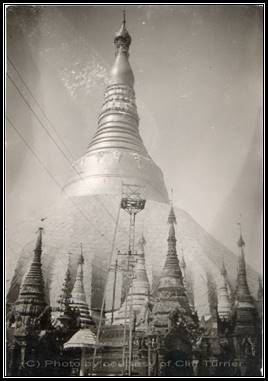
Shwe Dagon Pagoda,
Rangoon
Rangoon is home to the famous Shwe
Dagon Buddhist pagoda and a large party from the ship was given a conducted
tour. The pagoda has a large dome which is covered in gold leaf and
according to Encyclopaedia Brittanica has a height of 326 feet. My main
memory is of having to remove our shoes to enter the court yards of the
temple and being careful about where we put our feet as there were numerous
pigeons.
Another, more gruesome excursion, was to see
the embalmed bodies of assassinated Cabinet members in the Jubilee Hall. In
July 1947 two gunmen had burst into a cabinet meeting and killed several of
its members. Their bodies were put on view in glass coffins and were
not buried until independence was achieved.

Glass coffin of one of the assassinated
statesmen - Rangoon
I was standing on the jetty where
the Birmingham was berthed when sirens and hooters sounded at
mid-night to announce the end of British rule. A Burmese man was standing
next to me and with the arrogance of youth I asked him if he thought
independence would be better than British rule. His dignified response was
"Self-rule is more important than good rule".
The Union Jack was lowered for the last time
by Birmingham's Chief Yeoman of Signals; a picture in the newspaper carried
the words “Ben Hilton lowers the Union Jack.” Next morning the
last British Governor, Sir Hubert Rance, came aboard. He was accompanied to
the dockside by members of the new government and soon afterwards we
left Rangoon. I cannot remember now if we took Sir Hubert directly
to Colombo or to Trincomalee but I know he sailed for home
from Colombo in a Dutch liner, the Willem Ruys which was on its
maiden voyage.
Soon after arriving back in Trincomalee we
learned we were to go on a trip
to Madras and Calcutta in India - the
official name for such excursions was "good-will" but to the men
it was "flag-wagging". In Madras some of my
mess-mates met an Indian couple, Mr and Mrs Azariah, who invited them to
their home for a meal and told them to bring another friend. So the
previously mentioned foursome, Studwell, Hannan, Wheeler and Turner turned
up at the Azariah house in the suburb of Vepery. Mr Azariah was a tax
official and his wife Elizabeth was a lawyer but their house was, even
by my working-class standards, very shabby. However their hospitability was
far from shabby and we had a great evening although I cannot remember what
we ate. The Azariahs were Catholics and their four boys all had English
sounding first-names. The youngest was Eric and the oldest was
Christian; I have forgotten the names of the other two. We did not meet
Christian as he was in the army as an officer cadet. Later in the evening a
friend called in; he too was a lawyer but Mrs Azariah explained that he did
not practise in the courts as he came from the Bombay area and
spoke Gujarati. That was the first time I had ever heard of that
language but many years later I worked with a man who spoke it.
In Madras the main languages were Tamil, Telegu and Malayalalam.
We paid one or two more visits to the Azariahs and took the three boys
swimming and gave them a tour of the ship.
In Madras we had a visit from
Admiral Lord Mountbatten, Governor-General of India. He was the last
British Viceroy and was invited by the newly-independent India to
stay as Governor General after independence in August 1947. He gave the
assembled crew a talk about the last days of the British Raj and told us of
a Rajah whose hobby was breeding dogs and who gave his subjects a public
holiday whenever he mated his dogs. Mountbatten noticed an Indian reporter
standing on a gun turret and making notes. He gave an almost imperceptible
hint to his aide-de-camp who confiscated the reporter's notes.
We were inspected by Mountbatten; l was
standing near to my chief, Jim Stead, who was wearing the ribbon of the
Burma Star. During the war Mountbatten had been
Commander-in-Chief, South East Asia, and he stopped to have a few
words with Jim about the war in that area. After leaving India Mountbatten
resumed his naval career and eventually became First Sea Lord, the highest
office a naval officer can hold.
A day or so later, 30 January 1948, came the
news that Mr. Ghandhi, who for many years had been a leading member of
those seeking Indian independence, had been
assassinated. India was plunged into mourning and it was decided
that we should return to Trincomalee, leaving our visit
to Calcutta until after the mourning period ended.
When we did reach Calcutta I was
appalled at the sight of so much human misery and degradation. Many people
had no homes and spent their entire lives on the streets. One night l was
the Petty Officer in charge of the shore patrol. I think l had four
ratings, maybe six. Our function was to look out for any of the crew who
appeared likely to get into any kind of trouble but probably because of the
high price of alcohol we did not meet any. We were accompanied by a similar
patrol of Indian Army men.
Although the patrol had no trouble from crew
members I had a momentarily terrifying experience. It was full moon and the
occasion to bring some kind of effigy from a Hindu temple and carry it
through the streets. The effigy was carried on an ornate platform; poles
protruded from its four comers and about four men shouldered each of the
four poles. There was a huge crowd. Many of them were burning paper and
rubbing the resultant ash into their foreheads; the noise was deafening.
Suddenly one of the men carrying the thing stumbled and the whole thing
tipped over and broke into pieces. A loud wail came from the throng and for
a moment I thought that we white faces might somehow be thought to be
responsible for the disaster. But the police using their sticks soon
restored order and we returned to the ship unscathed.
Any trip ashore exposed us to multitudes of
beggars and I was pleased when our visit of a few days came to an end and
we left for Port Blair in the Andaman Islands in the Bay of Bengal.
This was the only place I have ever been to where it was necessary to take
medication to prevent malaria. The island on which Port Blair is situated
was at that time used by India as a penal colony and there was
little of interest to be seen but it also provided one of the highlights of
my life.
A party from the ship were taken, first by
motor boat and then by canoes, into the jungle to see a forestry operation.
After being felled the tree trunks were dragged by elephants to a railway
line where other elephants lifted them onto bogeys which ran on railway
lines to a river. When the laden bogeys reached the river more elephants
were waiting to tip the tree trunks into the water. I cannot recall if the
trees were milled locally or after being floated down the river,
loaded on to ships to be exported.
South Africa
Soon after returning to Trincomalee we
learned that we were to go to South Africa for about three
months, with a few days in Mauritius en
route. Mauritius was taken from the French during the Napoleonic
wars and French was still spoken there and as previously recounted I was
able to air my school-boy French. Most of the inhabitants were of Indian
origin, descendants of workers taken there to work in the sugar cane plantations.
Rum was produced on the island but I do not recall sampling it. What I do
remember is some horrible locally produced sherry. The quartet Studwell,
Hannan, Wheeler and Turner disposed of a full bottle in a shanty-like bar
somewhere in the interior of the island.
The interior could be reached by steam
trains which were wood-fired and the names of two townships, Quatre
Bournes and Curepipe have stayed in my memory. There was a British army
unit somewhere in the interior and several of us spent a few evenings in
the sergeants’ mess, sleeping there overnight and being returned to
the ship by army vehicles driven by African soldiers. At the time this did
not strike me as being odd but I now wonder why the British government felt
it necessary to have troops on a speck of land of no strategic importance.
We arrived in Simonstown, South
Africa, on the day that the result of the election which ousted General
Smuts as Prime Minister became known. Simonstown was a British naval base
known as the South Atlantic Station and we were to be on the station for
about three months to replace another cruiser which had gone
to Britain for a refit. Simonstown is about twenty miles
south of Capetown and is connected by a railway along which passenger trains
ran frequently.
On the first evening after our arrival I
travelled up to Capetown with one or two mess-mates to find the place abuzz
with excitement about the election result and many people bought us drinks.
After the expensive drinks in Rangoon and India and after the
horrible "sludge" in the Trincomalee canteen, South
Africa was a drinking man's paradise. Two breweries, Lion and Castle,
produced drinkable beer at a reasonable price and due to the vineyards
in Cape Province, brandy was very popular when taken with ginger ale
or other mixers.
There was a huge bar called Del Monico's
in Cape Town with a ceiling that looked like the night sky with
moving stars and it did not take long for the Birmingham crew to
make this our favourite night spot.
It was about now that I first went to
horse racing. The ship's painter, a mess-mate George Nuttal, asked me to go
with him on Union Day, a public holiday commemorating the union
of Transvaal, Cape Province, Natal and the Orange
Free State in the aftermath of the Boer war. Here l learned of
"the double", which meant picking the winners of two
specified races. George and I picked the first leg winner and l
had dreams of a good win but our second pick did not perform.
Then came a visit to Port
Elizabeth and East London. Going ashore in Port
Elizabeth I encountered a couple called Mundey who asked me to have
dinner with them in a restaurant. They turned out to be English, working in
Southern Rhodesia and having a holiday in South Africa. Some-time
later, when back in Simonstown, I saw them in Del Monicos and invited them
to the ship. I think they had a drop of rum in our mess and they certainly
went away with some duty-free cigarettes.
At one of these two ports a party from the
ship were given a tour of a car assembly plant - l think it belonged to
General Motors. Apart from that visit and meeting the Mundeys l recall
nothing of those two places.
Next stop was Durban, a much more
attractive place. Again l went to the races to see one of the big events of
South African racing, the July Cup. I did not pick the winner. Another
enjoyable trip was organised by a seaman’s mission to a place called
Amanzimptoto (or something like that). We had a boat trip on a river
running through acres of sugar cane. On returning to the mission we were
asked if we would like to go to the Sunday evening service. Several of the
men went but l was not among them. In Durban l went with my
friend Pat Hannan, a rugby enthusiast, to my first and last rugby game. It
was between Natal and Transvaal and seemed to me to be
just a lot of beefy men pushing and shoving.
Captain Haines had reached the top of the
captains’ seniority list and as he was not promoted to Rear Admiral
had to retire while we were in Durban and his replacement,
Captain Pakenham, joined us. He was to later play an important part in my
life.
Then it was back to Simonstown for the rest
of our stay in South Africa. When we left we were short of several
crew members who had deserted. Years later, in New Zealand, l worked
with Peter Trevett and in conversation found he had been in the navy at
Simonstown at the same time in the frigate H.M.S. Actaeon. Peter told me
one of the deserters, a gunnery petty officer called Chatfield, had
been caught slicing bacon in a grocer’s shop where he had found a
job. He was reduced to Able Seaman and sent to the Actaeon.
Ceylon and India (again)
On the voyage back to Trincomalee we called
briefly at one of the Maldive Islands where natives
paddled out in canoes with fresh fish. In return they were given newly
baked bread from the ship's bakery. At that time few British people could have
pointed to the Maldives on a map but it is now a tourist
destination. Nancy's great-nephew went there for his honeymoon; when
his mother told me this on the telephone l said "I've been there ~
three hours on a Sunday morning". She thought l was joking.
Soon after getting back to Trincomalee l had
two weeks leave at Diyatalawa in inland Ceylon. (Spelling of the place
may not be entirely accurate) The journey by bus took all day. We had a
stop in Kandy which was the capital when Sinhalese kings
ruled Ceylon. I saw the Temple of the Tooth – the tooth
being reputed to have been Buddha's - but did not go inside. The journey
took us over the Ramboda pass which I think was 6,000 feet above sea level
and at one stage we were held up by a ceremonial procession of elephants. It
may have been the Buddhist equivalent of the Harvest Festivals l attended
and enjoyed as a choir boy.

Temple of the Tooth, Kandy, Ceylon
For the first time l saw hillsides terraced
into small flat areas for growing rice and saw tea plantations. Due to its elevation
Diyatalawa was much cooler than Trincomalee and we wore our blue suits in
the evenings rather than tropical whites. It was possible to hire a bike so
l got into the surrounding country and one day came across a school where
there were some boys in saffron robes. An elderly man explained they were
learning Pali, a “dead" language in which many of the sacred
texts of Buddhism are written. Every evening flocks of huge bats flew
overhead and l was told they lived on fruit. I came across a dead one; it
had a wing span of about 30 centimetres.
Later I had another trip to Diyatalawa, this
time in charge of a prisoner going to the military prison there. Wee Jock,
a little Scotch seaman, had been caught asleep when he was guarding a
prisoner in the ship's cell. His offence was deemed to be more serious than
that of the man he was guarding so he was sentenced to a few days in the
military prison at Diyatalawa. I had two sailors to help me and as we left
the ship the Master at Arms asked me if l wanted Wee Jock handcuffed. Since
Wee Jock weighed about eight stone I said we would not subject him to that
indignity.
After an all day journey we delivered our
prisoner. I think we all enjoyed the journey and enjoyed a meal at a
government rest house with the voucher I had been given. It was more like
four pals having a day out than a serious business. This changed in an
instant as we entered the prison and Wee Jock was spoken to as if he was a
bad dog. I was disgusted that for what I thought was a minor misdemeanour,
four men and a Ceylonese driver spent two whole days travelling. The escort
and I had a night at the leave camp and returned to the ship on the next
day.
Recalling this somewhat unusual job reminds
me of another function totally unrelated to my normal work. I occasionally
was Petty Officer of the Day and had to be present at the rum issue. Every
day at 11.00 am the words "up spirits" came over the
loud-speakers and the P.O. of the Day joined an officer of the watch and a
man from the Stores branch in the spirit room deep down in the after end of
the ship. I cannot recall how the exact amount of rum to be issued on any
particular day was determined or how the rum was stored in the spirit room
but enough rum was taken to give every eligible man one eighth of a pint
and the P.O. of the Day had to be sure that no more or no less was taken.
We must have had at least 400 men eligible which meant that 50 pints, or
more than six gallons, were taken onto the deck amidships.
The mess-men for each of the Chief and Petty
Officers’ messes then collected enough neat rum for their messes and
the remainder of the rum was watered down in a large wooden tub bound with
brass rings and carrying, in large brass letters, "The King God Bless
Him". Then a rating for each of the other messes came for their
"two and one", so called because their rum was diluted by two
parts water to one part rum.
It was about the time of my trip as an
escort to the prison that we went to Colombo to go into dry dock,
mainly for a bottom scrape. Unlike merchant ships we spent a very small
proportion of our time at sea and in the warm tropical waters in-harbour
weeds grew quickly on the ship's bottom. This was enough to cause a
reduction in the maximum speed the ship could attain and also caused an
increase in fuel oil consumption when we did go to
sea. Colombo was a much more pleasant place
than Calcutta or Madras and we were able to go swimming
at Mount Lavinia on the outskirts.
Leaving the Navy
Towards the end of 1948 we went into
Singapore Dockyard for a refit and what became a turning point in my
life. Normally most of the crew would have been put into barracks while we
were in dry dock but for some reason which was never explained the crew of
the Norfolk remained in barracks after she had been refloated. So we had to
endure the heat and our sanitary arrangements on the side of the dock which
were totally inadequate for a full crew. For obvious reasons the
ship’s bathrooms and toilet facilities could not be used while in dry
dock.
When in Trincomalee I used to visit a
library attached to the shore station there and took to reading Hansard,
the record of Parliamentary proceedings in London. One day I read of a
Scottish M.P. called Willis who said in a debate that boys should not be allowed
to sign on in the navy as I had done. I wrote to Mr Willis and learned that
in his youth he too had joined the navy as an artificer apprentice,
served until he was 30 and then had gone into politics. I then started
writing to M.P.'s using an alphabetical list and had got through about 150
before going to Singapore. My letters all had the same theme; that it
was unethical to allow a boy not yet 16 to sign away 14 years of his life.
Many of the M.P.'s I wrote to referred my
letter to a minister in the government, the Civil Lord of the Admiralty
whose name I have forgotten. He had so many letters from M.P.'s that he
used a duplicate letter to reply and so I had many of these letters sent on
to me. They explained that the training of artificer apprentices was so
expensive that it was necessary for us to serve many years in recompense.
The situation in Singapore put me
onto a different tack. There were more than 100 Chief and Petty Officers in
the Birmingham and the number of W.C.s and washbasins in the
ablution facilities at the dry dock were totally inadequate so I wrote to
about 12 M.P.'s about this. Some-time later I went ashore one day and
bought a copy of the Singapore newspaper, The Straits Times, and
learned that one of them had raised the matter in Parliament and had been
told that the conditions were indeed as I had described them.
Next day I was summoned to appear before
Captain Pakenham and several other officers on the quarter deck. The
Captain opened the proceedings by saying "You will notice that you
still have your cap on." By this he meant that I was not being dealt
with as a defaulter on some kind of charge. He asked me why I had written
the letters instead of making a complaint to him as regulations permitted.
I replied that I had no faith in the complaints system. After a while I
told him that I did not wish to continue as I thought I might lose my
self-control and say something I could regret.
At this he said "Come with me" and
took me to his cabin. He offered me a cigarette (declined) and told me to
speak freely. He also remarked that I had been in the ship for three years,
longer than any other man, with an unblemished record and that my immediate
superiors were highly satisfied with my work performance. I told him I
hated the way we lived; no peace, no privacy. I also told him the stokers'
mess-deck was a disgrace to a civilised country. After a while he told me
that he could see that I was very unhappy in the navy and would try to get
me out of it.
I was still in the ship at Christmas 1948
but soon afterwards was sent to the sick quarters ashore at Trincomalee.
Looking back I think I should not have accepted that without protest -
there was nothing wrong with me but I was so keen to get out of the navy
that I accepted this. I forget how long I was in the sick quarters before
embarking in H.M.S. Sussex which was on its way home after a long spell on
the Far East station based at Hong Kong. In the Sussex I
carried out normal duties but as she was going home to be scrapped there
was not a lot of work done. Strangely I cannot remember the name of any
person I came into contact with in the ship. We called
at Aden and I went ashore long enough to buy 1,000 duty free
cigarettes but I cannot recall if we stopped at Malta or Gibraltar.
It was late February or early March when we
arrived at Portsmouth where the band of the Army's Sussex
Regiment was playing ‘Sussex by the Sea’ and wives and
children of crew members were waiting to greet their husbands and fathers.
I was whisked off to the Royal Naval Hospital at
nearby Gosport to see a psychiatrist who had the rank of Surgeon
Commander. We had a long talk. The only thing I remember is me telling him
how I sometimes used to go to the Barnetby cattle market with my Dad and
that the biscuits in the canteen at the market were always damp.
I was able to telephone the Queen's Arms pub
in Brigg to tell my Dad where I was. The Commander decided that I could not
be invalided out of the navy on medical grounds. My stay in the hospital
was short and then it was off to Brigg for some leave. Only one memory of
the leave remains - I went to Market Rasen races on Easter Monday, my
first experience of horse racing over hurdles and fences. In the
first race I backed a horse called Aces High ridden by Irishman and
champion jumping jockey Tim Moloney. It won.
After my leave I returned to the barracks
at Portsmouth fully expecting to be soon discharged but after a
day or two was told I was to go to H.M.S. Starling. I told the drafting
Master at Arms that I thought I was about to get my "ticket". He
said "You're going to the Starling." I went. The Starling was a
frigate that had been adapted as a training ship attached to a shore
establishment, H.M.S. Dryad, a navigation training school on the outskirts
of Portsmouth. We went to sea most days but returned to harbour almost
every night.
We also used to take parties of Sea Cadets
for a day at sea. They were brought to the ship by a Petty Officer who had
his mid-day meal in our mess and, by adding a little water to the rum allocated
to the mess, we were able to give him a tot. He told us he used to tell his
colleagues at the Dryad that it was a horrible job so that none of them
wanted to take his place.
Because we were in harbour most nights I
took a room at the Salvation Army for a very small payment and slept there
most nights. We were allowed to take 20 duty free cigarettes ashore per day
so I was able to build up quite a pile in my room for my Dad on my next
visit home.
Soon after I joined the Starling the captain
sent for me and handed me a form. It was headed Application for Discharge
and had two options, Free Discharge or Discharge by Purchase. Naturally I
went for the free option. I do not recall how long it took for the wheels
to go round but in June I was sent to H.M.S. Collingwood, the Navy's
electrical school near Portsmouth and from there I was ejected into Civvie
street. I was given the kit of civilian clothes that people who had been
conscripted into the armed forces were given when they finished their time.
Dad and step-mother were on holiday
in London so I stayed there for the rest of the week. Still in
uniform when I got to London I was able to get a room at the
Union Jack services club adjoining Waterloo Station. Then I took off my uniform
for the last time and went to meet Dad and my stepmother in my new clothes.
1948
Back in civilian Life and the Merchant
Navy
It was Royal Ascot week, perhaps the biggest
event in British horse racing, which always takes place in mid-June.
Thursday is Ascot Gold Cup day and we decided to go there by Greenline bus.
Royal Ascot lasts for four days, Tuesday to Friday inclusive, and the Royal
Family always entertains a large party at
nearby Windsor Castle for the racing. There is a straight
course of almost a mile at Ascot and after travelling from the castle by
car the royal party transfers into horse drawn carriages and drives down
the straight mile, past the grandstands into the Royal Enclosure.
So we saw George VI, Queen Elizabeth,
Princess Elizabeth with husband Duke of Edinburgh and Princess Margaret and
other lesser royals. My royalist Dad loved it. The Gold Cup was won by Lord
Derby's Alycidon. Lord Derby had three other runners in the race to
act as pacemakers as so often races over two and a half miles were run at a
dawdle for most of the trip with a sprint at the end. The pacemakers were
there to ensure a truly run race. We had a good day betting-wise but I only
remember the name of one of the winners I backed, Swallowtail, which had
been second or third in the Derby in his previous race.
Back in London we had a meal at the Lyons
Strand Corner House. Stepmother was feeling so pleased with herself she
gave the waiter a tip of half a crown which was a useful amount back then.
Half a crown is two shillings and sixpence; Britain also had
another coin, the florin, which was two shillings. I never understood why
it was thought necessary to have two coins of such close value, or why we
had half a crown but did not have a crown. After enjoying Gold
Cup day we decided to go to Ascot again on the following day.
We then returned to Brigg. Soon afterwards I
received a letter from the Admiralty addressed to Electrical Artificer
C.R.Turner with a cheque for money due to me. As I did not have a bank
account I could not cash the cheque so I sent it back asking for cash and
saying I was now Mr Turner. The money came in a more negotiable form in a
correctly addressed envelope.
I had always enjoyed any stays I had
in London and after a few days in Brigg I went back to London to
look for work. But putting pleasure before business I was
at Sandown Park race course within an hour of arriving at
King's Cross. The Eclipse Stakes is one of the big events in the British
racing year and I saw it won by Amour Drake from France.
The Victory Club for ex-service men had been
recently opened close to the Marble Arch end of Tottenham Court Road and I
joined this and took a room there and studied the Situations Vacant columns
in the newspapers. This bore no fruit so after some days I went
to a Labour Exchange and got a job as a clerk with the railways in an
office near Marylebone Station. The job involved records of freight carried
on the railway and was incredibly boring. At the same time I moved from the
Victory Club to lodgings in West Hampstead. The landlady was a
hard-faced woman. She had four other lodgers that I remember. We all had
separate rooms so it must have been quite a large house.
The next few weeks were probably the most
miserable of my life. I discovered that life in London was very
different from the occasional visit and I had a financial disaster. I kept
records of greyhound racing results at London tracks and came up
with what I thought was a sure-fire system. One Saturday night I went to
the dogs at Wembley to test the system and lost most of a week’s
wages. Monday saw me at a pawnbrokers shop near Charing
Cross station where I pawned my watch and binoculars so I could pay
the hard-faced landlady her week's rent. They were not in pawn for long. Since
then I have not visited either a pawnbroker or a greyhound track.
A young man at my work had been in the
Merchant Navy and I think it must have been talks I had with him that made
me think in that direction. I stayed at the railway job for only six weeks
and went back to Brigg. I took a job with an electrical contractor. For
most of the six weeks with him the main job was wiring new houses being
built at an airforce base at Swinderby
between Lincoln and Newark. This involved travel of almost
an hour each way in the back of a van and I hated this job too so, at Dad's
suggestion, I wrote to the shipping company Alfred Holt
at Liverpool. I was called to Liverpool for an
interview and given a job as ship's electrician. I did not know that a
chance meeting in Liverpool would change my life.
The Merchant Navy
At first I worked on ships at
the Birkenhead docks where cargo for the company's ships was
loaded and stayed in lodgings arranged by the company. This was with
two sisters, the Misses Wolfenden, whose late father had been a chief
engineer with the company. The younger sister, in her forties and working
in an office, was the archetypical sour spinster but her elder sister who
looked after the boarders was very different. The house shone and the
meals, in spite of rationing which was still in force were good.
I also did a spell on nights on a ship
called the Deucalion. I lived on board and only had to get out of bed if
needed. I was free during the day and during that time had two trips
to Haydock Park races and also saw Laurence Olivier's film
of Shakespeare's Henry V.
My first voyage for Alfred Holt's Blue
Funnel line was only as far as Glasgow, in the Astyanax. All Blue
Funnel ships were named after the Greek heroes of Homer's Odyssey. When
ships returned from foreign voyages their crews went on leave and temporary
crews manned the ships for coastal voyages. We went to Glasgow to
load cargo for the ship's next foreign voyage.
I had to be in the engine room when leaving
harbour and when the order to start the engine was given I nearly jumped
out of my skin. The Astyanax was a motor ship driven by a diesel engine and
to start the engine a blast of compressed air was driven into the cylinders
and this created a very loud noise. All my previous experience had been in
steam ships.
Thanks to my Seaman's Record Book, which I
still have, I know the return trip from Liverpool to Glasgow was
from 4 November 1949 to 11 November 1949. About all I remember
of Glasgow was going to see Scotland play Wales in
a soccer match at Hampden Park. Then it was back to the shore gang and
probably spending most of the time at the Misses Wolfenden and having a few
days at home at Christmas time. On 30 January 1950 I went
to Glasgow by overnight sleeper to join the Peleus. Arriving
about breakfast time on New Year's Eve I was whisked off to the shipping
office to sign on. New Year's Eve is a time of celebration in Scotland and
I was looking forward to a few beers ashore in the evening but by lunch
time the Peleus and I were sailing down the Clyde bound for Liverpool where
I signed off on New Year’s Day about 30 hours after signing on.
Life in the Merchant Navy was very different
from that in the Royal Navy. On the ships I had my own cabin complete with
a wash basin. A steward made up my bed and every evening left tea making
material and sandwiches in case I had to get up during the night. The food
was far superior to that in naval ships and as I soon discovered became
epicurean when we had passengers.
To the East Indies
On 31 January 1949 I signed on as second
electrician in the Anchises, a sister ship to the Astayanax. They were
quite new ships built after the war. Most of our cargo was destined for
Labuan, a small island off the north coast of Borneo, and consisted
mainly of bags of cement and galvanized iron window frames for an oil
refinery which was being built there. The first electrician, there were
only two of us, was in his forties and had been at sea for many years.
Ships of the Anchises class carried 14
passengers. Most of them were not travelling for pleasure but were
employees and families of various firms or government departments. This of
course was in the days before air travel became so common. We had two
other passengers - race horses bound for Singapore. They were housed in
two large wooden boxes on deck and did not come out of the boxes until we
reached that port.
Dinner on the first night out astonished me;
it was real luxury. Course followed course; soup, fish, entree, main dish,
dessert and cheese and biscuits were served by the stewards. We ate in
the saloon with the passengers but at a separate table and we were not
encouraged to fraternise with them. Drinks were now dirt cheap. A
double gin, a tenth of a bottle, was sixpence; whisky was eight pence and a
small bottle of Bass beer sixpence. My pay was about one pound a day; a
pound was 240 pence. I took a liking to gin and tonic and the first
electrician and I had one every night before dinner.
The first part of the voyage, as far
as Gibraltar, was the roughest I ever encountered but I was not sea
sick. We had a young engineer who had been to sea before, had given it up,
and was now giving it a second trial. He hardly kept down a mouthful of
food and was looking very frail by the time we reached Gibraltar. He
left the sea again at the end of the voyage.
Our main work in the early part of the
voyage was overhauling the winches and the switch gear which controlled
them. They would be used to discharge and later load cargo. We had one
helper, a Chinese man. The engine room crew was Cantonese but the deck crew
and stewards were British. From our Chinese helper I heard the only Chinese
I ever learned. As 10.00 am approached he would look at his watch and say
"Yum cha" (tea time) and disappear to the aft end of the ship where
the Chinese crew was housed.
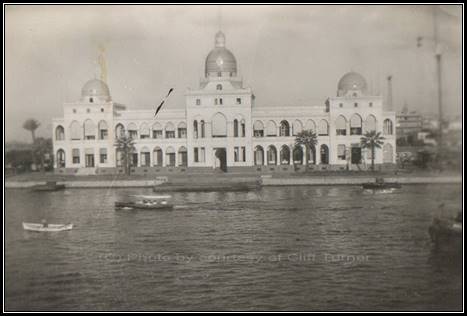
Suez Canal Offices, Port Said
First stop was Port Said, prior to
entering the Suez Canal. In the Royal Navy we hired a searchlight
and an operator from the Canal Company but Blue Funnel ships carried their
own. The searchlights consisted of two carbon rods mounted in front of a
large concave mirror. The rods almost touched each other and when a Direct
Current voltage was applied to them they produced an intense light. A
mechanism ensured that as the rods burned away they were moved back towards
each other so that their tips remained a constant distance apart. The canal
was lined close to each bank by floating reflectors much like the cat's
eyes we see on the roads and the light from the searchlight reflected from
the mirrors enabled the pilot, a canal employee, to keep the ship in the
middle of the canal. One of the two electricians had to be standing by the
searchlight when it was in use. I learned that it can be very cold at
night in Egypt.
After a brief re-fuelling stop
at Aden it was across the Indian Ocean to Singapore and
then to Labuan to unload the bulk of our cargo. We
then went around to Tarakan and Sandakan on the north east coast
of Borneo. Sandakan was in British Borneo but Tarakan was in
what had been part of the Dutch East Indies and was now part of newly
independent Indonesia. Tarakan was a poverty stricken place. At the
end of the jetty at which we were berthed we sold cigarettes for fistfuls
of paper money but when we reached the township about all we could buy was
some vile sticky soft drink. At Sandakan we took several Chinese workers on
board and went up a broad river to load logs. I wish now that I had
enquired about the name of the river; all I know is that it was in the
British part of Borneo.
The tree trunks were floated down the river
from the interior. Two trunks of a lighter wood were lashed to one which
would not float. I think the heavier wood was the more valuable. There was
certainly a lot of fuss from the British forestry official when one was
mishandled and sank. It was a nightmare job loading the tree trunks; they
had to be lowered into the holds at an angle and in the holds there were
ropes and pulleys to get them stowed. The Chinese workers
from Sandakan were employed on this job. The first mate, who
oversaw the operation, aged visibly in the several days we were up the
river.
The logs were guided to the ship by pygmies
from the interior. Nothing could persuade them to set foot on the ship. Once
they had
attached the winch ropes to the logs their
job was done. We were told that their main reason for doing this work was
to get money to buy salt. Almost every day brought periods of torrential
rain. When the rain stopped and the sun reappeared clouds of steam rose
from the dense jungle on the sides of the river.
The Anchises' captain limited us to four
bottles of beer per day and also limited the daily amount of spirits we
could buy. The British forestry man told us we could have a case of gin at
five shillings a bottle. For some now forgotten reason I was the only one
with ready money so I bought the gin and recipients paid me when we
returned to Liverpool.
At last the logs were all safely stowed. We
dropped the Chinese labourers, who had lived on deck in makeshift
accommodation, back at Sandakan and headed for Singapore. We
probably loaded cargo at Port Swettenham and Penang on the west coast
of Malaysia. I have certainly visited those two ports more than once
but am not sure of which voyage I did so. Tin, which is mined in Malaysia,
was an important cargo. Tin is very valuable and was exported from Port
Swettenham. When we were loading it there were always armed guards
watching. The port is named for Sir Frank Swettenham who was a colonial
administrator in the area in about 1880.
Another important export
of Malaysia was palm oil, extracted from nuts, which is used in
soap manufacture. I think it was in Singapore
that a large party of Chinese women, all
dressed in blue blouses and shiny black trousers, boarded the ship to clean
the holds which were to be used to hold the palm oil. They brought long
bamboo poles which were lashed together to make scaffolding and from this
scaffolding they thoroughly scrubbed the sides of the hold. It is necessary
to keep palm oil warm so pipes were laid in the bottom of the hold in which
steam was circulated once the oil had been loaded. Long tubes accessible
from the deck allowed a thermometer to be lowered to take the oil's
temperature and the ship's carpenter had the job of doing this several times
a day until the oil was pumped out in Liverpool.
But before getting to Liverpool we went
to London to discharge the tree trunks. When the hatches were
opened there was an appalling pong from the river water which had been
unavoidably loaded with the timber. I think we arrived on a Thursday and on
the next day I got permission to go to the races
at Kempton Park on the outskirts of London. I had a
disastrous day; the only winner was the bosun who asked me to back a horse
called Eclat for him and which duly won.
In the first race I saw Lester Piggott who
was to go on to be one of England's most successful jockeys of all
time; he was then 15 years old. In that race I backed a horse called The
Accused ridden by champion jockey Gordon Richards. Close to the post he
appeared to be well in the lead and I was getting ready to collect my
winnings. Then a red shirt flashed past him. It was worn by Lester Piggott
on a horse called Tancred.
I consoled myself for my bad day thinking I
would go again on the next day and recoup my losses by backing a horse
called Peter Flower in the Great Jubilee Handicap. Peter Flower
duly obliged but I was not there to see him. By the time of the first race
we were sailing down the Thames heading for Liverpool. The tree trunks
that the Chinese workers had taken so long to load were discharged quickly
by the London dockers who had the convenience of dock-side cranes
instead of having to use the ship's winches.
I was paid off in Liverpool on 15
May; the trip had lasted about 10 weeks. I went home for some leave of
which my main memory is of going to the races at York and Epsom. I must
have been an optimist as I went to Brigg market place in the hope of
somehow getting a ride to York. I met an old Brigg worthy there,
Edmund Thorpe, a retired coal merchant. When I told him I was hoping to get
to York he pointed to a group of men and told me they were going
to the races. They said I could join them. When their transport arrived it
was driven by an ex-school fellow, Frank Proctor, and was a hire car. I
offered to pay my share of the car hire; it was one pound which was a very
reasonable fare for a round trip of at least a hundred miles. The three men
were all prosperous farmers; two of them had sons who had been at school
with me.
Feeling flush with money after getting paid
for the voyage I went into Tattersall’s ring at a cost of thirty
shillings. This gave access to the parade ring around which horses walked
prior to racing. There I saw Johnny Proctor, owner of the Lord Nelson pub
in Brigg and also owner of Sheila's Cottage which won the Grand National in
1948. Mr Proctor knew my Dad and Granddad so I introduced myself and asked
him if his horse, Keepatwoatwo, was going to win. He thought it would not
and he proved to be right. The winner of the big race that day was
Miraculous Atom owned by a man who farmed near Brigg.
A few days later I set off for Epsom to see
the Oaks, a classic race for three year old fillies, and the Coronation Cup
on the following day. I wish now that I had stayed one more day to see
the Derby, England's most prestigious flat race, which Disraeli
described as the ‘Blue Ribband of the Turf’.
I rejoined the Anchises in time to sign on
for the next voyage on 6 June. This was to be a shorter trip. First
to Bangkok, where we lay off shore and discharged cargo into lighters
and so none of the crew got ashore, and then to Singapore, Port
Swettenham and Penang. This trip I had a new first electrician
from Newcastle. We paid off in Liverpool on 29 August.
I cannot recall how I spent my leave in
Brigg. It did not last very long as only two weeks later I signed on in the
Peleus. This was one of the best ships in Blue Funnel's large fleet. It was
powered by a steam turbine, was about 20% bigger than the Anchises and
carried forty passengers. It also carried enough refrigerated cargo to
warrant an extra engineer who did not keep watches in the engine room but
looked after the refrigerating equipment. The first electrician,
Clarrie Bentley, had been at sea for several years. I did not like him
much and when we got back to Liverpool the electrical
superintendent at head office was keen to know how I had got on with him. I
learned that my predecessor had complained about him and had asked for
another ship. I told the boss that although we were not bosom pals I found
him a capable man and I would be quite happy to sail with him again. This
all got back to Clarrie who told me that he was grateful for my words.
After leaving Liverpool we went
to Rotterdam to load more cargo and I had a trip ashore. Back
in England strict food rationing was still in force but
in Holland, which had suffered almost five years of German occupation,
food appeared to be plentiful. From Rotterdam we went to Plymouth
Sound for a brief stop to pick up mail and then left bound for Port
Said. We had the usual short stay there and then through the Canal
to Aden where again we only had the brief stop for taking on fuel
oil.
After Singapore it was on to Hong
Kong where we berthed on the Kowloon side of the harbour. A ferry
took me over to the other side where I went up The Peak by the rack railway
but do not remember much else except that, as everywhere in the East,
drinks were expensive so I stuck to my sixpenny double gins on the ship.
Visiting Hong Kong again in 1996 I was amazed by the number of sky scrapers
and the amount of building work which was still going on despite the
imminent transfer from British rule. Only the ferries appeared the same.
Japan
Now came my first visit
to Japan; Yokohama, Kobe, and Nagoya.
From Yokohama I went by train to Tokyo which was still
largely in ruins from the war but I saw the emperor's palace which appeared
to be unscathed. At one place I bought Nana a pair of locally made vases. The
last time I saw them they were in my Auntie Flo's house at Barnetby. She
acquired them when Nana died.
Sitting here almost sixty years later I am
finding it strange that I recall so little about Japan. One memory is
of seeing a black American soldier with his wife and two little girls at
the Yokohama railway station. Japan still had American
occupation troops present. Another is of being in a bar and hearing
the song Mona Lisa with the words ‘Are you warm, are you real Mona
Lisa, or are you just a lovely work of art?’
On one of the two occasions on which I went
to Japan we also went to a port in north-east China to load
liquid eggs but I have no recollection of the name of the port or how the
liquid eggs were handled. By this time the Communist government of Mao
Zedong ruled all China. There were armed guards near the ship and we were
not allowed ashore. Chan, our Cantonese helper, would sometimes say
"By and by Chiang Kai-shek come back" but Chan and Chiang were
both doomed to be disappointed.
I did two voyages in the Peleus. On both
trips we called at a European port on the way home but I cannot remember in
which order. Going to Genoa we passed through the Straits of Messina
which separate Sicily from mainland Italy and there was
something of a panic as we got too close to a ferry but all ended well. The
docks in Genoa were close to lots of bars and although it was
quite late when we berthed several of us went ashore to be introduced to
new names in the drinks line. Marsala all'uovo was a sweet
wine with eggs somehow incorporated and another tipple I tried
was Lacrima Christi, tears of Christ.
I went ashore next day and heard a man
singing for money in the street, perhaps only in Italy would one be likely
to hear a busker sing Che gelida manina (Your
tiny hand is frozen) from Puccini's opera La Boheme.
To reach Marseilles we passed
through the Straits of Bonifacio between Corsica and Sardinia so
I had a glimpse of the island where Napoleon was born. I had one run ashore
in Marseilles but remember little of the town.
My first trip in the Peleus ended in
Liverpool on 17 December 1950. The return trip to Japan had taken
just over three months. I spent my leave in Brigg and rejoined the ship
at Birkenhead soon after Christmas. The company gave a Christmas
bonus of a month's pay and I think it was on 9 January 1951 that with two
shipmates I went over to Head Office in Liverpool to collect
it. We then went to a pub which had the rather incongruous name of
‘The Temple’.

Cliff
Turner and his wife Nancy in later years
Contact
Us - Home
|